- Products & ServicesProducts & Services
- SolutionsSolutions
- PricingPricing
- CompanyCompany
- ResourcesResources

en
en

10+
Years of experience
600+
Customers protected across Web2 and Web3
200,000+
Threats blocked
5,000+
Digital assets protected
24/7
Continuous monitoring and response

A Red Team Assessment is an in-depth cybersecurity exercise that simulates a deliberate real-world attack against the organization to measure detection and response, not simply list vulnerabilities. Unlike Pentesting, it follows a specific business objective over several weeks, places no artificial limit on attack vectors, and does not warn the defense team in advance.
Red Teaming helps the organization understand risk across realistic cyberattack paths and measure which critical assets are exposed. It also measures how long the defense takes to respond, enabling the earliest practical remediation plan.
Red Team operations go far beyond the scope of a traditional Pentest, uncovering security risks across your technology, people and processes so a response plan can be put in place in time.

Measure how prepared your organization is, in both people and technology, to respond to a targeted attack.
Identify and classify the threats that could harm your organization's systems, data and critical assets.
Simulated attacks reveal hidden vulnerabilities and forgotten assets that attackers could try to exploit.
Determine the business impact and focus exploitation on the assets and systems that matter most.
Red Teaming shows the Blue Team how attackers operate, improving detection capability and response playbooks.
Red Teaming results show exactly where to invest to improve your current security posture.
A Red Teaming engagement is more complex than conventional cybersecurity services. As a rough guide, your organization should meet 4 of the 5 conditions below
 The environment has undergone Pentesting at least once and critical findings have been remediatedMonitoring technologies such as SIEM, EDR, or NDR are deployed and operationalizedAn internal or outsourced professional SOC or incident-response team is in placeThe organization has inventoried its digital assets and identified the critical assets that must be protectedThe organization is prepared to withstand unexpected attacks involving facilities, people, and suppliers
Red Teaming reveals risks that other assessments cannot measure. Book a session to agree the attack objective and scope.
Your organization is not ready for a Red Team engagement yet. Pentesting is a better fit for establishing the security baseline.


Choose between Red Team, Purple Team, or Assumed Breach based on whether your goal is to measure capability or address a known cybersecurity risk.
(Assumed Breach)
Assume an attacker already has a foothold and focus on testing internal attack risk.
Fits limited budgets or timelines, or engagements where phishing access is expected.
(Red Team)
The defense team is not warned. Simulate an end-to-end cyberattack against a specific business objective.
Fits organizations that need an unbiased measure of real defensive capability.


(Purple Team)
Attack and defense teams test together to validate detection and tune controls immediately.
Fits organizations that need to close security gaps as early as possible.

(Assumed Breach)
Assume an attacker already has a foothold and focus on testing internal attack risk.
Fits limited budgets or timelines, or engagements where phishing access is expected.

(Red Team)
(Purple Team)
Deployment process
CyStack Red Teaming is delivered in line with the international MITRE ATT&CK framework. At the end of the project you know exactly which risks were stopped and which got through.
Collect public intelligence about infrastructure, people, suppliers, and leaked data to map the attack surface before touching any system.
Map the attack surface
Initial intelligence
Collect public information
Profile target personnel
Collect public intelligence about infrastructure, people, suppliers, and leaked data to map the attack surface before touching any system.
Map the attack surface
Initial intelligence
Collect public information
Profile target personnel
Objectives
Red Team attacks can target a wide range of objectives inside and outside your organization. Below are some of the Red Team scenarios we can run for your business
Move from an ordinary workstation to Domain Admin to test whether an attacker can control identities across the organization.

Extract password hashes, Kerberos material, or credentials stored in memory, files, and legacy scripts.
Request service access, then crack captured hashes offline to recover passwords for highly privileged service accounts on the system.
Exploit loose ACLs, nested groups, or misconfigured delegation to escalate toward Domain Admin.
Abuse trust relationships between domains, Golden Ticket, Silver Ticket, or DCSync to maintain domain-wide control.
Move from an ordinary workstation to Domain Admin to test whether an attacker can control identities across the organization.
Extract password hashes, Kerberos material, or credentials stored in memory, files, and legacy scripts.
Request service access, then crack captured hashes offline to recover passwords for highly privileged service accounts on the system.
Exploit loose ACLs, nested groups, or misconfigured delegation to escalate toward Domain Admin.
Abuse trust relationships between domains, Golden Ticket, Silver Ticket, or DCSync to maintain domain-wide control.

with experts recognized in global security Halls of Fame

to produce an optimal roadmap that supports business growth

so your team can track risk and act quickly

to help your organization respond to threats at any time

to reduce cost and focus penetration-testing effort where it matters

from network environments to internal applications and software
Our team is honored for its contributions to discovering and responsibly disclosing critical security vulnerabilities in major products and services worldwide









We do not just follow trends, we help shape them. Recognition from the international security community is the strongest assurance of the red teaming quality you receive

BlackHat USA
BlackHat Asia

XCon focus

T2FI

FIDO APAC

Taiwan CYBERSEC







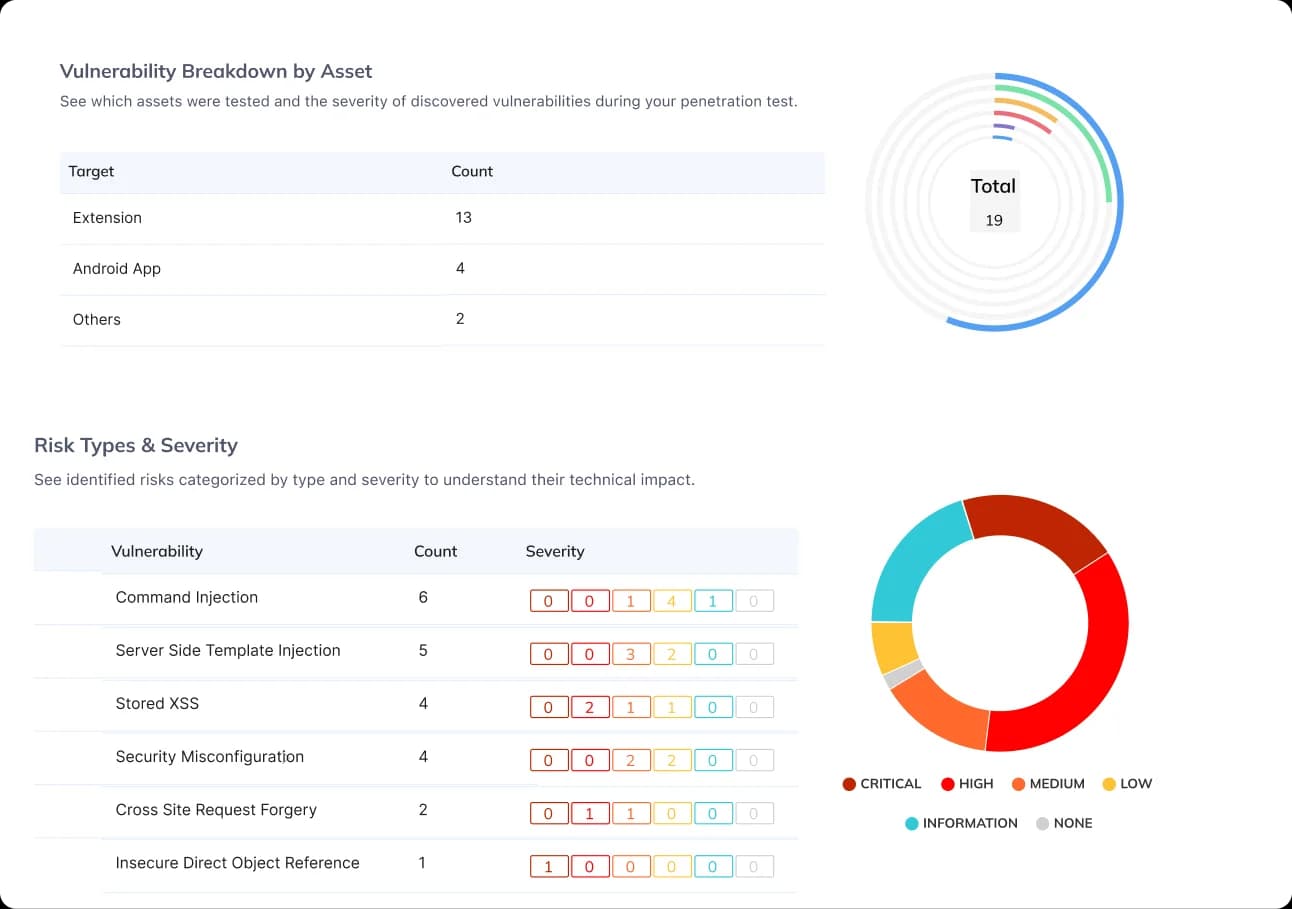
An accessible report for business leaders covering the objectives, demonstrated impact, and remediation direction.
Detailed technical evidence that helps engineering teams understand, reproduce, and remediate each risk quickly.
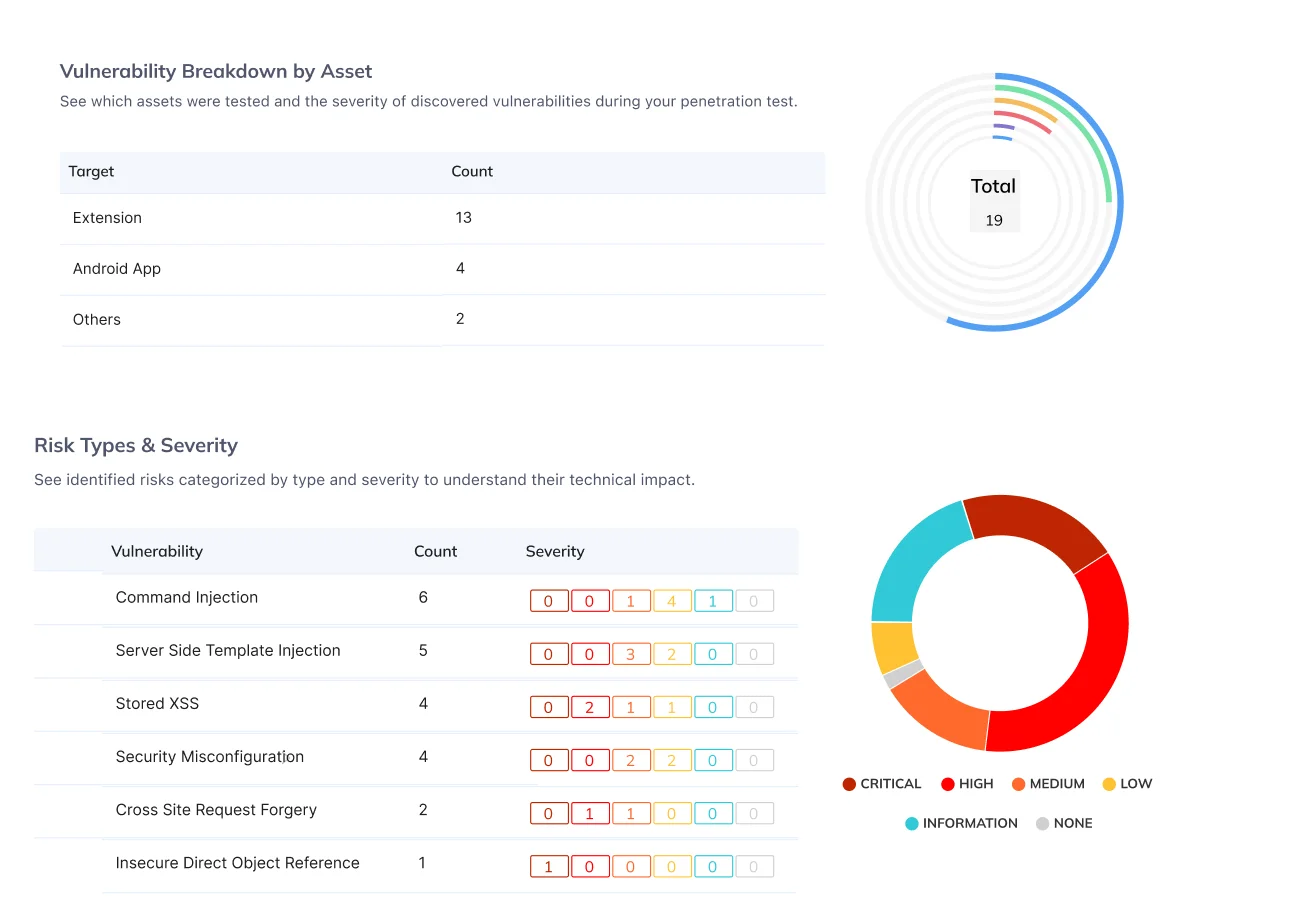
A complete analysis of identified security risks, their severity, attack path, and potential business impact.
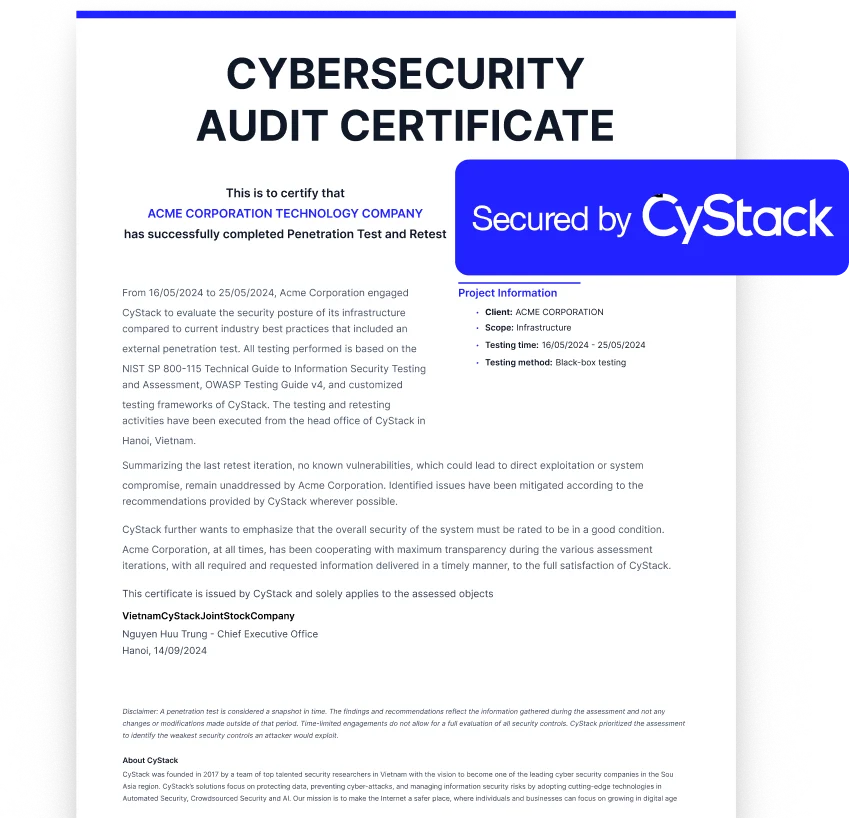
Tactical and strategic recommendations followed by retesting to confirm that remediation is complete.
Discover the success stories of our customers

To stay competitive, we needed to ship faster. CyStack’s community‑driven security on WhiteHub helped us improve platform safety at scale - without slowing development.

Nguyen Thanh Tung
Head of Product Security, One Mount