CWE-184: Incomplete List of Disallowed Inputs

What is CWE-184?

MITRE CWE

The product implements a protection mechanism that relies on a list of inputs (or properties of inputs) that are not allowed by policy or otherwise require other action to neutralize before additional processing takes place, but the list is incomplete.

Verify to analyze this CWE entry

A short verification protects the official data source and prevents automated AI abuse.

Official definition

MITRE CWE

The product implements a protection mechanism that relies on a list of inputs (or properties of inputs) that are not allowed by policy or otherwise require other action to neutralize before additional processing takes place, but the list is incomplete.

Detailed description

CyStack is analyzing this CWE entry. The page will update automatically when the bilingual analysis is ready.

Characteristics

CyStack is analyzing this CWE entry. The page will update automatically when the bilingual analysis is ready.
  • Denylist / Deny List: This is used by CWE and CAPEC instead of other commonly-used terms. Its counterpart is allowlist.
  • Blocklist / Block List: This is often used by security tools such as firewalls, email or web gateways, proxies, etc.
  • Blacklist / Black List: This term is frequently used, but usage has been declining as organizations have started to adopt other terms.

Modes of introduction

  • Implementation: Developers often try to protect their products against malicious input by checking against lists of known bad inputs, such as special characters that can invoke new commands. However, such lists often only address the most well-known bad inputs. As a quick fix, developers might rely on these lists instead of addressing the root cause of the issue. See [REF-141].
  • Architecture and Design: The design might rely solely on detection of malicious inputs as a protection mechanism.

Common consequences

CyStack is analyzing this CWE entry. The page will update automatically when the bilingual analysis is ready.
  • Access Control

    Bypass Protection Mechanism

    Attackers may be able to find other malicious inputs that were not expected by the developer, allowing them to bypass the intended protection mechanism.

Mitigations

CyStack is analyzing this CWE entry. The page will update automatically when the bilingual analysis is ready.
  • Implementation · Input ValidationDo not rely exclusively on detecting disallowed inputs. There are too many variants to encode a character, especially when different environments are used, so there is a high likelihood of missing some variants. Only use detection of disallowed inputs as a mechanism for detecting suspicious activity. Ensure that you are using other protection mechanisms that only identify "good" input - such as lists of allowed inputs - and ensure that you are properly encoding your outputs.

Detection methods

CyStack is analyzing this CWE entry. The page will update automatically when the bilingual analysis is ready.
  • Black BoxExploitation of a vulnerability with commonly-used manipulations might fail, but minor variations might succeed.

Representative vulnerabilities

CyStack is analyzing this CWE entry. The page will update automatically when the bilingual analysis is ready.

These examples illustrate this CWE entry and are not an exhaustive list of related vulnerabilities.

  • CVE-2024-6091Chain: AI agent platform does not restrict pathnames containing internal "/./" sequences (CWE-55), leading to an incomplete denylist (CWE-184) that does not prevent OS command injection (CWE-78)
  • CVE-2024-4315Chain: API for text generation using Large Language Models (LLMs) does not include the "\" Windows folder separator in its denylist (CWE-184) when attempting to prevent Local File Inclusion via path traversal (CWE-22), allowing deletion of arbitrary files on Windows systems.
  • CVE-2024-44335Chain: filter only checks for some shell-injection characters (CWE-184), enabling OS command injection (CWE-78)
  • CVE-2008-2309product uses a denylist to identify potentially dangerous content, allowing attacker to bypass a warning
  • CVE-2005-2782PHP remote file inclusion in web application that filters "http" and "https" URLs, but not "ftp".
  • CVE-2004-0542Programming language does not filter certain shell metacharacters in Windows environment.
  • CVE-2004-0595XSS filter doesn't filter null characters before looking for dangerous tags, which are ignored by web browsers. MIE and validate-before-cleanse.
  • CVE-2005-3287Web-based mail product doesn't restrict dangerous extensions such as ASPX on a web server, even though others are prohibited.
  • CVE-2004-2351Resultant XSS when only <script> and <style> are checked.
  • CVE-2005-2959Privileged program does not clear sensitive environment variables that are used by bash. Overlaps multiple interpretation error.
  • CVE-2005-1824SQL injection protection scheme does not quote the "\" special character.
  • CVE-2005-2184Detection of risky filename extensions prevents users from automatically executing .EXE files, but .LNK is accepted, allowing resultant Windows symbolic link.
  • CVE-2007-1343Product uses list of protected variables, but accidentally omits one dangerous variable, allowing external modification
  • CVE-2007-5727Chain: product only removes SCRIPT tags (CWE-184), enabling XSS (CWE-79)
  • CVE-2006-4308Chain: product only checks for use of "javascript:" tag (CWE-184), allowing XSS (CWE-79) using other tags
  • CVE-2007-3572Chain: OS command injection (CWE-78) enabled by using an unexpected character that is not explicitly disallowed (CWE-184)
  • CVE-2002-0661"\" not in list of disallowed values for web server, allowing path traversal attacks when the server is run on Windows and other OSes.

Sources and references

References

CWE™ Program, operated by The MITRE Corporation. Copyright © 2006–2026, The MITRE Corporation. The MITRE Corporation hereby grants you a non-exclusive, royalty-free license to use CWE for research, development, and commercial purposes. CWE Terms of Use.

Learn more

Run an in-depth assessment with complete web risk management

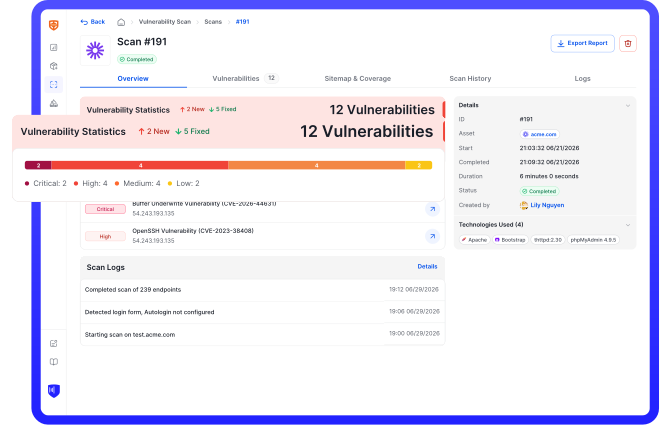
CyStack VulnScan continuously discovers assets, validates vulnerabilities, and helps security teams prioritize remediation across the organization.

Explore CyStack VulnScan
CyStack VulnScan dashboard