CWE-79: Improper Neutralization of Input During Web Page Generation ('Cross-site Scripting')

What is CWE-79?

CyStack AI

The product does not neutralize or incorrectly neutralizes user-controllable input before it is placed in output that is used as a web page that is served to other users.

CyStack analysis based on the official MITRE CWE source 4.20 (04/30/2026).

Official definition

MITRE CWE

The product does not neutralize or incorrectly neutralizes user-controllable input before it is placed in output that is used as a web page that is served to other users.

There are many variants of cross-site scripting, characterized by a variety of terms or involving different attack topologies. However, they all indicate the same fundamental weakness: improper neutralization of dangerous input between the adversary and a victim.

The Same Origin Policy states that browsers should limit the resources accessible to scripts running on a given web site, or "origin", to the resources associated with that web site on the client-side, and not the client-side resources of any other sites or "origins". The goal is to prevent one site from being able to modify or read the contents of an unrelated site. Since the World Wide Web involves interactions between many sites, this policy is important for browsers to enforce. When referring to XSS, the Domain of a website is roughly equivalent to the resources associated with that website on the client-side of the connection. That is, the domain can be thought of as all resources the browser is storing for the user's interactions with this particular site.

Detailed description

There are many variants of cross-site scripting, characterized by a variety of terms or involving different attack topologies. However, they all indicate the same fundamental weakness: improper neutralization of dangerous input between the adversary and a victim.

Characteristics

Abstraction: Base. Structure: Simple. Status: Stable. Likelihood of exploit: High. Introduction phases relate to how the weakness manifests during software implementation. Terminology includes XSS variants such as stored, reflected, and DOM-based. Platforms commonly involve web technologies and web servers. Related weakness characteristics include input handling, output encoding, and defense-in-depth considerations.

  • XSS: A common abbreviation for Cross-Site Scripting.
  • HTML Injection: Used as a synonym of stored (Type 2) XSS.
  • Reflected XSS / Non-Persistent XSS / Type 1 XSS: Used when a server application reads data directly from the HTTP request and reflects it back in the HTTP response.
  • Stored XSS / Persistent XSS / Type 2 XSS: Used when a server-side application stores dangerous data in a database, message forum, visitor log, or other trusted data store. At a later time, the dangerous data is subsequently read back into the application and included in dynamic content.
  • DOM-Based XSS / Type 0 XSS: Used when a client-side application performs the injection of XSS into the page by manipulating the Domain Object Model (DOM).
  • CSS: In the early years after initial discovery of XSS, "CSS" was a commonly-used acronym. However, this would cause confusion with "Cascading Style Sheets," so usage of this acronym has declined significantly.

Modes of introduction

  • Implementation: REALIZATION: This weakness is caused during implementation of an architectural security tactic.

Common consequences

Scopes and impacts include bypassing protection mechanisms, reading application data, executing unauthorized code, and potentially compromising user confidentiality, integrity, and availability. The most common outcome is disclosure of sensitive information such as cookies; other outcomes may include redirection, content manipulation, or malware execution on end-user systems.

  • Access Control, Confidentiality

    Bypass Protection Mechanism, Read Application Data

    The most common attack performed with cross-site scripting involves the disclosure of private information stored in user cookies, such as session information. Typically, a malicious user will craft a client-side script, which -- when parsed by a web browser -- performs some activity on behalf of the victim to an attacker-controlled system (such as sending all site cookies to a given E-mail address). This could be especially dangerous to the site if the victim has administrator privileges to manage that site. This script will be loaded and run by each user visiting the web site. Since the site requesting to run the script has access to the cookies in question, the malicious script does also.

  • Integrity, Confidentiality, Availability

    Execute Unauthorized Code or Commands

    In some circumstances it may be possible to run arbitrary code on a victim's computer when cross-site scripting is combined with other flaws, for example, "drive-by hacking."

  • Confidentiality, Integrity, Availability, Access Control

    Execute Unauthorized Code or Commands, Bypass Protection Mechanism, Read Application Data

    The consequence of an XSS attack is the same regardless of whether it is stored or reflected. The difference is in how the payload arrives at the server. XSS can cause a variety of problems for the end user that range in severity from an annoyance to complete account compromise. Some cross-site scripting vulnerabilities can be exploited to manipulate or steal cookies, create requests that can be mistaken for those of a valid user, compromise confidential information, or execute malicious code on the end user systems for a variety of nefarious purposes. Other damaging attacks include the disclosure of end user files, installation of Trojan horse programs, redirecting the user to some other page or site, running "Active X" controls (under Microsoft Internet Explorer) from sites that a user perceives as trustworthy, and modifying presentation of content.

Mitigations

Architecture and Design: Use vetted libraries or frameworks that prevent this weakness or provide safer output generation. Implement encoding libraries such as Microsoft's Anti-XSS library, OWASP ESAPI Encoding, or Apache Wicket. Implementation and Architecture/Design: Understand data contexts and encoding requirements; apply appropriate encoding to all non-alphanumeric characters for data output to web pages. Architecture and Design: Identify all input entry points and minimize untrusted inputs. Architecture: Ensure server-side checks mirror any client-side checks to avoid bypasses. Architecture Principle: Use structured mechanisms that separate data from code to enforce encoding automatically where possible. Implementation: Specify and enforce consistent output encodings (e.g., UTF-8) to prevent downstream misinterpretation.

  • Architecture and Design · Libraries or FrameworksUse a vetted library or framework that does not allow this weakness to occur or provides constructs that make this weakness easier to avoid [REF-1482]. Examples of libraries and frameworks that make it easier to generate properly encoded output include Microsoft's Anti-XSS library, the OWASP ESAPI Encoding module, and Apache Wicket.
  • Implementation, Architecture and DesignUnderstand the context in which your data will be used and the encoding that will be expected. This is especially important when transmitting data between different components, or when generating outputs that can contain multiple encodings at the same time, such as web pages or multi-part mail messages. Study all expected communication protocols and data representations to determine the required encoding strategies. For any data that will be output to another web page, especially any data that was received from external inputs, use the appropriate encoding on all non-alphanumeric characters. Parts of the same output document may require different encodings, which will vary depending on whether the output is in the: - HTML body - Element attributes (such as src="XYZ") - URIs - JavaScript sections - Cascading Style Sheets and style property etc. Note that HTML Entity Encoding is only appropriate for the HTML body. Consult the XSS Prevention Cheat Sheet [REF-724] for more details on the types of encoding and escaping that are needed.
  • Architecture and Design, Implementation · Attack Surface ReductionUnderstand all the potential areas where untrusted inputs can enter your software: parameters or arguments, cookies, anything read from the network, environment variables, reverse DNS lookups, query results, request headers, URL components, e-mail, files, filenames, databases, and any external systems that provide data to the application. Remember that such inputs may be obtained indirectly through API calls.Effectiveness: LimitedThis technique has limited effectiveness, but can be helpful when it is possible to store client state and sensitive information on the server side instead of in cookies, headers, hidden form fields, etc.
  • Architecture and DesignFor any security checks that are performed on the client side, ensure that these checks are duplicated on the server side, in order to avoid CWE-602. Attackers can bypass the client-side checks by modifying values after the checks have been performed, or by changing the client to remove the client-side checks entirely. Then, these modified values would be submitted to the server.
  • Architecture and Design · ParameterizationIf available, use structured mechanisms that automatically enforce the separation between data and code. These mechanisms may be able to provide the relevant quoting, encoding, and validation automatically, instead of relying on the developer to provide this capability at every point where output is generated.
  • Implementation · Output EncodingUse and specify an output encoding that can be handled by the downstream component that is reading the output. Common encodings include ISO-8859-1, UTF-7, and UTF-8. When an encoding is not specified, a downstream component may choose a different encoding, either by assuming a default encoding or automatically inferring which encoding is being used, which can be erroneous. When the encodings are inconsistent, the downstream component might treat some character or byte sequences as special, even if they are not special in the original encoding. Attackers might then be able to exploit this discrepancy and conduct injection attacks; they even might be able to bypass protection mechanisms that assume the original encoding is also being used by the downstream component. The problem of inconsistent output encodings often arises in web pages. If an encoding is not specified in an HTTP header, web browsers often guess about which encoding is being used. This can open up the browser to subtle XSS attacks.
  • ImplementationWith Struts, write all data from form beans with the bean's filter attribute set to true.
  • Implementation · Attack Surface ReductionTo help mitigate XSS attacks against the user's session cookie, set the session cookie to be HttpOnly. In browsers that support the HttpOnly feature (such as more recent versions of Internet Explorer and Firefox), this attribute can prevent the user's session cookie from being accessible to malicious client-side scripts that use document.cookie. This is not a complete solution, since HttpOnly is not supported by all browsers. More importantly, XmlHttpRequest and other powerful browser technologies provide read access to HTTP headers, including the Set-Cookie header in which the HttpOnly flag is set.Effectiveness: Defense in Depth
  • Implementation · Input ValidationAssume all input is malicious. Use an "accept known good" input validation strategy, i.e., use a list of acceptable inputs that strictly conform to specifications. Reject any input that does not strictly conform to specifications, or transform it into something that does. When performing input validation, consider all potentially relevant properties, including length, type of input, the full range of acceptable values, missing or extra inputs, syntax, consistency across related fields, and conformance to business rules. As an example of business rule logic, "boat" may be syntactically valid because it only contains alphanumeric characters, but it is not valid if the input is only expected to contain colors such as "red" or "blue." Do not rely exclusively on looking for malicious or malformed inputs. This is likely to miss at least one undesirable input, especially if the code's environment changes. This can give attackers enough room to bypass the intended validation. However, denylists can be useful for detecting potential attacks or determining which inputs are so malformed that they should be rejected outright. When dynamically constructing web pages, use stringent allowlists that limit the character set based on the expected value of the parameter in the request. All input should be validated and cleansed, not just parameters that the user is supposed to specify, but all data in the request, including hidden fields, cookies, headers, the URL itself, and so forth. A common mistake that leads to continuing XSS vulnerabilities is to validate only fields that are expected to be redisplayed by the site. It is common to see data from the request that is reflected by the application server or the application that the development team did not anticipate. Also, a field that is not currently reflected may be used by a future developer. Therefore, validating ALL parts of the HTTP request is recommended. Note that proper output encoding, escaping, and quoting is the most effective solution for preventing XSS, although input validation may provide some defense-in-depth. This is because it effectively limits what will appear in output. Input validation will not always prevent XSS, especially if you are required to support free-form text fields that could contain arbitrary characters. For example, in a chat application, the heart emoticon ("<3") would likely pass the validation step, since it is commonly used. However, it cannot be directly inserted into the web page because it contains the "<" character, which would need to be escaped or otherwise handled. In this case, stripping the "<" might reduce the risk of XSS, but it would produce incorrect behavior because the emoticon would not be recorded. This might seem to be a minor inconvenience, but it would be more important in a mathematical forum that wants to represent inequalities. Even if you make a mistake in your validation (such as forgetting one out of 100 input fields), appropriate encoding is still likely to protect you from injection-based attacks. As long as it is not done in isolation, input validation is still a useful technique, since it may significantly reduce your attack surface, allow you to detect some attacks, and provide other security benefits that proper encoding does not address. Ensure that you perform input validation at well-defined interfaces within the application. This will help protect the application even if a component is reused or moved elsewhere.
  • Architecture and Design · Enforcement by ConversionWhen the set of acceptable objects, such as filenames or URLs, is limited or known, create a mapping from a set of fixed input values (such as numeric IDs) to the actual filenames or URLs, and reject all other inputs.
  • Operation · FirewallUse an application firewall that can detect attacks against this weakness. It can be beneficial in cases in which the code cannot be fixed (because it is controlled by a third party), as an emergency prevention measure while more comprehensive software assurance measures are applied, or to provide defense in depth [REF-1481].Effectiveness: ModerateAn application firewall might not cover all possible input vectors. In addition, attack techniques might be available to bypass the protection mechanism, such as using malformed inputs that can still be processed by the component that receives those inputs. Depending on functionality, an application firewall might inadvertently reject or modify legitimate requests. Finally, some manual effort may be required for customization.
  • Operation, Implementation · Environment HardeningWhen using PHP, configure the application so that it does not use register_globals. During implementation, develop the application so that it does not rely on this feature, but be wary of implementing a register_globals emulation that is subject to weaknesses such as CWE-95, CWE-621, and similar issues.

Detection methods

Automated Static Analysis: Use tools targeting this weakness; data-flow analysis helps reduce false positives but cannot guarantee complete coverage. Black Box tests and the XSS Cheat Sheet can help discover diverse payloads; stored XSS may require testing through data stores before activation.

  • Automated Static AnalysisUse automated static analysis tools that target this type of weakness. Many modern techniques use data flow analysis to minimize the number of false positives. This is not a perfect solution, since 100% accuracy and coverage are not feasible, especially when multiple components are involved.Effectiveness: Moderate
  • Black BoxUse the XSS Cheat Sheet [REF-714] or automated test-generation tools to help launch a wide variety of attacks against your web application. The Cheat Sheet contains many subtle XSS variations that are specifically targeted against weak XSS defenses.Effectiveness: ModerateWith Stored XSS, the indirection caused by the data store can make it more difficult to find the problem. The tester must first inject the XSS string into the data store, then find the appropriate application functionality in which the XSS string is sent to other users of the application. These are two distinct steps in which the activation of the XSS can take place minutes, hours, or days after the XSS was originally injected into the data store.

Representative vulnerabilities

Representative examples include CVE-2024-49038 (XSS in AI assistant), CVE-2024-54142 (plugin with HTML entities enabling XSS), CVE-2021-25926 (Python Library Manager did not neutralize search term for reflected XSS), CVE-2021-25963 (e-commerce platform did not escape error pages), and other listed CVEs as representative samples.

These examples illustrate this CWE entry and are not an exhaustive list of related vulnerabilities.

  • CVE-2024-49038XSS in AI assistant
  • CVE-2024-54142Plugin that enables AI features allows input with html entities, leading to XSS
  • CVE-2021-25926Python Library Manager did not sufficiently neutralize a user-supplied search term, allowing reflected XSS.
  • CVE-2021-25963Python-based e-commerce platform did not escape returned content on error pages, allowing for reflected Cross-Site Scripting attacks.
  • CVE-2021-1879Universal XSS in mobile operating system, as exploited in the wild per CISA KEV.
  • CVE-2020-3580Chain: improper input validation (CWE-20) in firewall product leads to XSS (CWE-79), as exploited in the wild per CISA KEV.
  • CVE-2014-8958Admin GUI allows XSS through cookie.
  • CVE-2017-9764Web stats program allows XSS through crafted HTTP header.
  • CVE-2014-5198Web log analysis product allows XSS through crafted HTTP Referer header.
  • CVE-2008-5080Chain: protection mechanism failure allows XSS
  • CVE-2006-4308Chain: incomplete denylist (CWE-184) only checks "javascript:" tag, allowing XSS (CWE-79) using other tags
  • CVE-2007-5727Chain: incomplete denylist (CWE-184) only removes SCRIPT tags, enabling XSS (CWE-79)
  • CVE-2008-5770Reflected XSS using the PATH_INFO in a URL
  • CVE-2008-4730Reflected XSS not properly handled when generating an error message
  • CVE-2008-5734Reflected XSS sent through email message.
  • CVE-2008-0971Stored XSS in a security product.
  • CVE-2008-5249Stored XSS using a wiki page.
  • CVE-2006-3568Stored XSS in a guestbook application.
  • CVE-2006-3211Stored XSS in a guestbook application using a javascript: URI in a bbcode img tag.
  • CVE-2006-3295Chain: library file is not protected against a direct request (CWE-425), leading to reflected XSS (CWE-79).

Sources and references

References

CWE™ Program, operated by The MITRE Corporation. Copyright © 2006–2026, The MITRE Corporation. The MITRE Corporation hereby grants you a non-exclusive, royalty-free license to use CWE for research, development, and commercial purposes. CWE Terms of Use.

Learn more

Run an in-depth assessment with complete web risk management

CyStack VulnScan continuously discovers assets, validates vulnerabilities, and helps security teams prioritize remediation across the organization.

Explore CyStack VulnScan
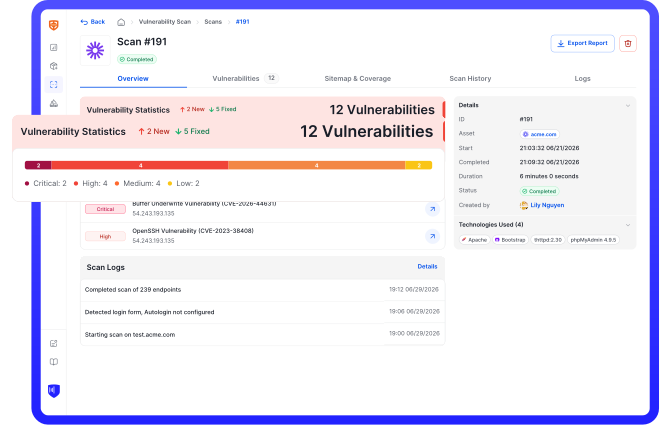
CyStack VulnScan dashboard