CWE-434: Unrestricted Upload of File with Dangerous Type

What is CWE-434?

MITRE CWE

The product allows the upload or transfer of dangerous file types that are automatically processed within its environment.

Verify to analyze this CWE entry

A short verification protects the official data source and prevents automated AI abuse.

Official definition

MITRE CWE

The product allows the upload or transfer of dangerous file types that are automatically processed within its environment.

Detailed description

CyStack is analyzing this CWE entry. The page will update automatically when the bilingual analysis is ready.

Characteristics

CyStack is analyzing this CWE entry. The page will update automatically when the bilingual analysis is ready.
  • Unrestricted File Upload: Used in vulnerability databases and elsewhere, but it is insufficiently precise. The phrase could be interpreted as the lack of restrictions on the size or number of uploaded files, which is a resource consumption issue.

Modes of introduction

  • Implementation
  • Architecture and Design: OMISSION: This weakness is caused by missing a security tactic during the architecture and design phase.

Common consequences

CyStack is analyzing this CWE entry. The page will update automatically when the bilingual analysis is ready.
  • Integrity, Confidentiality, Availability

    Execute Unauthorized Code or Commands

    Arbitrary code execution is possible if an uploaded file is interpreted and executed as code by the recipient. This is especially true for web-server extensions such as .asp and .php because these file types are often treated as automatically executable, even when file system permissions do not specify execution. For example, in Unix environments, programs typically cannot run unless the execute bit is set, but PHP programs may be executed by the web server without directly invoking them on the operating system.

Mitigations

CyStack is analyzing this CWE entry. The page will update automatically when the bilingual analysis is ready.
  • Architecture and DesignGenerate a new, unique filename for an uploaded file instead of using the user-supplied filename, so that no external input is used at all.[REF-422] [REF-423]
  • Architecture and Design · Enforcement by ConversionWhen the set of acceptable objects, such as filenames or URLs, is limited or known, create a mapping from a set of fixed input values (such as numeric IDs) to the actual filenames or URLs, and reject all other inputs.
  • Architecture and DesignConsider storing the uploaded files outside of the web document root entirely. Then, use other mechanisms to deliver the files dynamically. [REF-423]
  • Implementation · Input ValidationAssume all input is malicious. Use an "accept known good" input validation strategy, i.e., use a list of acceptable inputs that strictly conform to specifications. Reject any input that does not strictly conform to specifications, or transform it into something that does. When performing input validation, consider all potentially relevant properties, including length, type of input, the full range of acceptable values, missing or extra inputs, syntax, consistency across related fields, and conformance to business rules. As an example of business rule logic, "boat" may be syntactically valid because it only contains alphanumeric characters, but it is not valid if the input is only expected to contain colors such as "red" or "blue." Do not rely exclusively on looking for malicious or malformed inputs. This is likely to miss at least one undesirable input, especially if the code's environment changes. This can give attackers enough room to bypass the intended validation. However, denylists can be useful for detecting potential attacks or determining which inputs are so malformed that they should be rejected outright. For example, limiting filenames to alphanumeric characters can help to restrict the introduction of unintended file extensions.
  • Architecture and DesignDefine a very limited set of allowable extensions and only generate filenames that end in these extensions. Consider the possibility of XSS (CWE-79) before allowing .html or .htm file types.
  • Implementation · Input ValidationEnsure that only one extension is used in the filename. Some web servers, including some versions of Apache, may process files based on inner extensions so that "filename.php.gif" is fed to the PHP interpreter.[REF-422] [REF-423]
  • ImplementationWhen running on a web server that supports case-insensitive filenames, perform case-insensitive evaluations of the extensions that are provided.
  • Architecture and DesignFor any security checks that are performed on the client side, ensure that these checks are duplicated on the server side, in order to avoid CWE-602. Attackers can bypass the client-side checks by modifying values after the checks have been performed, or by changing the client to remove the client-side checks entirely. Then, these modified values would be submitted to the server.
  • ImplementationDo not rely exclusively on sanity checks of file contents to ensure that the file is of the expected type and size. It may be possible for an attacker to hide code in some file segments that will still be executed by the server. For example, GIF images may contain a free-form comments field.
  • ImplementationDo not rely exclusively on the MIME content type or filename attribute when determining how to render a file. Validating the MIME content type and ensuring that it matches the extension is only a partial solution.
  • Architecture and Design, Operation · Environment HardeningRun your code using the lowest privileges that are required to accomplish the necessary tasks [REF-76]. If possible, create isolated accounts with limited privileges that are only used for a single task. That way, a successful attack will not immediately give the attacker access to the rest of the software or its environment. For example, database applications rarely need to run as the database administrator, especially in day-to-day operations.
  • Architecture and Design, Operation · Sandbox or JailRun the code in a "jail" or similar sandbox environment that enforces strict boundaries between the process and the operating system. This may effectively restrict which files can be accessed in a particular directory or which commands can be executed by the software. OS-level examples include the Unix chroot jail, AppArmor, and SELinux. In general, managed code may provide some protection. For example, java.io.FilePermission in the Java SecurityManager allows the software to specify restrictions on file operations. This may not be a feasible solution, and it only limits the impact to the operating system; the rest of the application may still be subject to compromise. Be careful to avoid CWE-243 and other weaknesses related to jails.Effectiveness: LimitedThe effectiveness of this mitigation depends on the prevention capabilities of the specific sandbox or jail being used and might only help to reduce the scope of an attack, such as restricting the attacker to certain system calls or limiting the portion of the file system that can be accessed.

Detection methods

CyStack is analyzing this CWE entry. The page will update automatically when the bilingual analysis is ready.
  • Dynamic Analysis with Automated Results InterpretationAccording to SOAR [REF-1479], the following detection techniques may be useful: ``` Cost effective for partial coverage: ``` Web Application Scanner Web Services Scanner Database ScannersEffectiveness: SOAR Partial
  • Dynamic Analysis with Manual Results InterpretationAccording to SOAR [REF-1479], the following detection techniques may be useful: ``` Cost effective for partial coverage: ``` Fuzz Tester Framework-based FuzzerEffectiveness: SOAR Partial
  • Manual Static Analysis - Source CodeAccording to SOAR [REF-1479], the following detection techniques may be useful: ``` Highly cost effective: ``` Focused Manual Spotcheck - Focused manual analysis of source Manual Source Code Review (not inspections)Effectiveness: High
  • Automated Static Analysis - Source CodeAccording to SOAR [REF-1479], the following detection techniques may be useful: ``` Highly cost effective: ``` Source code Weakness Analyzer Context-configured Source Code Weakness AnalyzerEffectiveness: High
  • Architecture or Design ReviewAccording to SOAR [REF-1479], the following detection techniques may be useful: ``` Highly cost effective: ``` Formal Methods / Correct-By-Construction ``` Cost effective for partial coverage: ``` Inspection (IEEE 1028 standard) (can apply to requirements, design, source code, etc.)Effectiveness: High

Representative vulnerabilities

CyStack is analyzing this CWE entry. The page will update automatically when the bilingual analysis is ready.

These examples illustrate this CWE entry and are not an exhaustive list of related vulnerabilities.

Sources and references

References

CWE™ Program, operated by The MITRE Corporation. Copyright © 2006–2026, The MITRE Corporation. The MITRE Corporation hereby grants you a non-exclusive, royalty-free license to use CWE for research, development, and commercial purposes. CWE Terms of Use.

Learn more

Run an in-depth assessment with complete web risk management

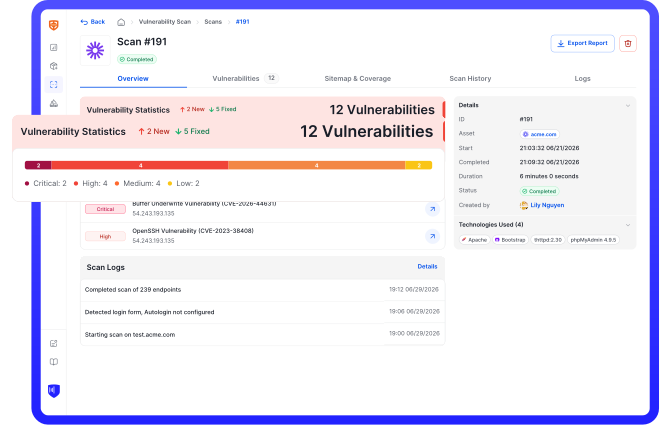
CyStack VulnScan continuously discovers assets, validates vulnerabilities, and helps security teams prioritize remediation across the organization.

Explore CyStack VulnScan
CyStack VulnScan dashboard