www.dbcl.vimaru.edu.vn
TRƯỜNG ĐẠI HỌC HÀNG HẢI VIỆT NAM
 Industry
- Science and Education
- Origin
- Vietnam
- Global rank
- #338,527
- Rank in Vietnam
- #7,898
 Vietnam
 Updated at

en
TRƯỜNG ĐẠI HỌC HÀNG HẢI VIỆT NAM
IndustryOriginGlobal rankRank in VietnamUpdated at The higher the score, the more externally observable protections the system has recorded. This page does not certify that the website is reputable, legitimate, or completely free of vulnerabilities.

As of August 27, 2026 at 02:04, www.dbcl.vimaru.edu.vn has a security score of 59/100 (grade U – “Unrated”), but this result is provisional because some required evidence is incomplete. CyStack’s automated assessment recorded 12 issues to review after completing 58% of applicable checks. The website owner should address “HTTPS/TLS endpoint reachability” first, then review the remaining items in order of impact.

At assessment time, CyStack did not find www.dbcl.vimaru.edu.vn or related infrastructure on any scam, phishing, or malware warning list after checking 5 online reputation sources. This result reflects external observations; it does not guarantee absolute safety or verify the organization’s legal status or reputation.
Addresses, servers and services that are visible from the Internet.
Frequently asked questions
A valid SSL certificate still does not prove that www.dbcl.vimaru.edu.vn is safe, legitimate, or free of scam signals. For a more complete assessment, this report also checks phishing and malware, exposed email records, IPs and open ports, subdomains, technologies, and CVEs that may apply to observed versions.
HTTPS on www.dbcl.vimaru.edu.vn could not be reached during this assessment, so its SSL certificate and transport encryption could not be evaluated.
Review HTTPS and certificateData sources
CyStack compiles scan results from its internal cybersecurity monitoring systems, including CyStack VulnScan and CyStack Threat Intelligence, together with publicly available Internet data. The assessment only observes and analyzes information already available; it does not attempt unauthorized access, test passwords, send exploit code, or change or disrupt the assessed system.
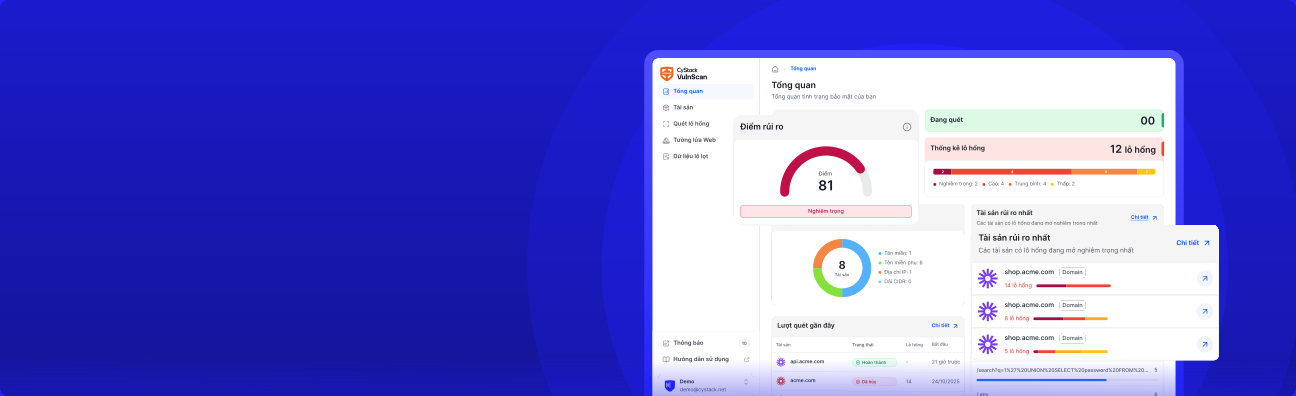
CyStack VulnScan continuously discovers assets, validates vulnerabilities, and helps security teams prioritize remediation across the enterprise.
These 3 failed checks or warnings have the greatest impact on the result for www.dbcl.vimaru.edu.vn.
Why it matters
This check only confirms whether a TLS handshake can be established with at least one tested resolved endpoint on the HTTPS port. Certificate trust, hostname identity, validity, chain, protocol, and cryptographic strength are evaluated separately.
What to do
Provide the entire website over HTTPS using a certificate trusted by common browsers.
Diagnostic information
The scanner could not complete a TLS handshake with the HTTPS endpoint during this assessment.
Evidence and check scope
This is the port on which the scanner attempted a TLS connection. The port number alone does not prove that the port is open or that HTTPS works.
Why it matters
Remote administration services such as RDP, VNC, Docker, Kubernetes, and management consoles are high-value targets. Public exposure allows anyone on the Internet to attempt passwords or exploit an unpatched service.
What to do
Remove direct Internet access and require a VPN, a hardened access gateway, or trusted source networks; also use MFA where supported.
Why it matters
Older services such as Telnet, FTP, and unencrypted mail or directory protocols can send passwords and data in readable form. Anyone able to observe the network path may capture them.
What to do
Disable the legacy service or replace it with an encrypted alternative such as SSH, SFTP, HTTPS, or the secure version of the mail protocol.
Evidence and check scope
Each public IP is grouped with its open services, identified products and any CVEs that may apply to the observed version.
 203.162.246.123static.vnpt.vn
 ProFTPDProFTPDVersion not visible
There are currently 71 exposed email records matching the vimaru.edu.vn domain. These records may be old or already resolved. The website owner should verify them before resetting passwords or locking related accounts.
Review exposed email recordsThe assessment identified 5 technologies on www.dbcl.vimaru.edu.vn. Only 1 had a version reliable enough for accurate CVE matching.
Review technologies and CVEsThe assessment observed 1 public IPs and 5 open ports for www.dbcl.vimaru.edu.vn. An open port is not the same as a vulnerability, but the website owner should keep every public service updated and appropriately restrict access.
Review IPs and open portsThe assessment observed 341+ public subdomains of vimaru.edu.vn. This list can reveal additional entry points such as APIs, administration systems, or test environments, but it does not mean that every subdomain is risky.
Review discovered subdomainsEvidence and check scope
 Openssh15 potential CVEsOpenssh9.6p115 potential CVEsCVSS 9.4
Potential CVEs for this product
ssh in OpenSSH before 10.4 can have a use-after-free when a server changes its host key during a key re-exchange. (This outcome occurs only on the client side.)
NvdProduct not identified
Product not identified
 BootstrapJ
 JqueryN
 NginxBootstrapUI FrameworksVersion not visible
Bootstrap is a free and open-source CSS framework directed at responsive, mobile-first front-end web development. It contains CSS and JavaScript-based design templates for typography, forms, buttons, navigation, and other interface components.
getbootstrap.comA security regression (CVE-2006-5051) was discovered in OpenSSH's server (sshd). There is a race condition which can lead sshd to handle some signals in an unsafe manner. An unauthenticated, remote attacker may be able to trigger it by failing to authenticate within a set time period.
NvdIn OpenSSH before 10.3, a file downloaded by scp may be installed setuid or setgid, an outcome contrary to some users' expectations, if the download is performed as root with -O (legacy scp protocol) and without -p (preserve mode).
NvdOpenSSH before 10.3 mishandles the authorized_keys principals option in uncommon scenarios involving a principals list in conjunction with a Certificate Authority that makes certain use of comma characters.
NvdIn sshd in OpenSSH before 10.4, DisableForwarding=yes was supposed to take precedence over PermitTunnel=yes, but did not.
Nvdsshd in OpenSSH before 10.4 allows remote attackers to cause a denial of service (resource consumption from excessive authentication attempts) because MaxAuthTries was mishandled for GSSAPIAuthentication.
NvdA vulnerability was found in OpenSSH when the VerifyHostKeyDNS option is enabled. A machine-in-the-middle attack can be performed by a malicious machine impersonating a legit server. This issue occurs due to how OpenSSH mishandles error codes in specific conditions when verifying the host key. For an attack to be considered successful, the attacker needs to manage to exhaust the client's memory resource first, turning the attack complexity high.
NvdOpenSSH before 10.3 can use unintended ECDSA algorithms. Listing of any ECDSA algorithm in PubkeyAcceptedAlgorithms or HostbasedAcceptedAlgorithms is misinterpreted to mean all ECDSA algorithms.
Nvdsshd in OpenSSH before 10.4 has an undocumented security-relevant behavior: GSSAPIStrictAcceptorCheck has no value if the server is in Windows Active Directory.
Nvdsshd in OpenSSH before 10.4 does not always honor the minimum authentication delay.
Nvdsftp in OpenSSH before 10.4 does not properly constrain the location of downloaded files when "sftp server:/path ." is used with an attacker-controlled server.
Nvdscp in OpenSSH before 10.4 may place a file in the parent directory of an intended directory when the copy occurs between two remote destinations.
Nvdinternal-sftp in sshd in OpenSSH before 10.4 recognizes only the first 9 command-line arguments, which can be important if a later command-line argument would have helped to ensure the intended security properties of an SFTP connection.
NvdIn sshd in OpenSSH before 10.0, the DisableForwarding directive does not adhere to the documentation stating that it disables X11 and agent forwarding.
NvdOpenSSH before 10.3 omits connection multiplexing confirmation for proxy-mode multiplexing sessions.
NvdJqueryJavaScript LibrariesVersion not visiblejQuery is a JavaScript library which is a free, open-source software designed to simplify HTML DOM tree traversal and manipulation, as well as event handling, CSS animation, and Ajax.
jquery.comNginxReverse Proxies · Web ServersVersion not visibleNginx is a web server that can also be used as a reverse proxy, load balancer, mail proxy and HTTP cache.
nginx.org/enRecently completed assessments, prioritizing websites with a similar sector, country or security grade for easier comparison.