What is CWE-863?
CWE-863 is Incorrect Authorization. The flaw arises when the product performs an authorization check when an actor attempts to access a resource or perform an action, but it does not correctly perform the check.
Analyzing data...

CWE-863 is Incorrect Authorization. The flaw arises when the product performs an authorization check when an actor attempts to access a resource or perform an action, but it does not correctly perform the check.
Analyzing data...
No vulnerability data for CWE-863
No vulnerability data in CISA KEV for CWE-863
The product performs an authorization check when an actor attempts to access a resource or perform an action, but it does not correctly perform the check.
An access control list (ACL) represents who/what has permissions to a given object. Different operating systems implement (ACLs) in different ways. In UNIX, there are three types of permissions: read, write, and execute. Users are divided into three classes for file access: owner, group owner, and all other users where each class has a separate set of rights. In Windows NT, there are four basic types of permissions for files: "No access", "Read access", "Change access", and "Full control". Windows NT extends the concept of three types of users in UNIX to include a list of users and groups along with their associated permissions. A user can create an object (file) and assign specified permissions to that object.
| Impact | Scope | Explanation |
|---|---|---|
| Read Application Data, Read Files or Directories | Confidentiality | An attacker could bypass intended access restrictions to read sensitive data, either by reading the data directly from a data store that is not correctly restricted, or by accessing insufficiently-protected, privileged functionality to read the data. |
| Modify Application Data, Modify Files or Directories | Integrity | An attacker could bypass intended access restrictions to modify sensitive data, either by writing the data directly to a data store that is not correctly restricted, or by accessing insufficiently-protected, privileged functionality to write the data. |
| Gain Privileges or Assume Identity, Bypass Protection Mechanism | Access Control | An attacker could bypass intended access restrictions to gain privileges by modifying or reading critical data directly, or by accessing privileged functionality. |
| Execute Unauthorized Code or Commands | Confidentiality, Integrity, Availability | An attacker could use elevated privileges to execute unauthorized commands or code. |
| DoS: Crash, Exit, or Restart, DoS: Resource Consumption (CPU), DoS: Resource Consumption (Memory), DoS: Resource Consumption (Other) | Availability | An attacker could gain unauthorized access to resources on the system and excessively consume those resources, leading to a denial of service. |
| Method | Approach | Effectiveness |
|---|---|---|
| Automated Static Analysis | Automated static analysis is useful for detecting commonly-used idioms for authorization. A tool may be able to analyze related configuration files, such as .htaccess in Apache web servers, or detect the usage of commonly-used authorization libraries. Generally, automated static analysis tools have difficulty detecting custom authorization schemes. Even if they can be customized to recognize these schemes, they might not be able to tell whether the scheme correctly performs the authorization in a way that cannot be bypassed or subverted by an attacker. | Limited |
| Automated Dynamic Analysis | Automated dynamic analysis may not be able to find interfaces that are protected by authorization checks, even if those checks contain weaknesses. | - |
| Manual Analysis | This weakness can be detected using tools and techniques that require manual (human) analysis, such as penetration testing, threat modeling, and interactive tools that allow the tester to record and modify an active session. Specifically, manual static analysis is useful for evaluating the correctness of custom authorization mechanisms.These may be more effective than strictly automated techniques. This is especially the case with weaknesses that are related to design and business rules. However, manual efforts might not achieve desired code coverage within limited time constraints. | Moderate |
| Manual Static Analysis - Binary or Bytecode | According to SOAR [REF-1479], the following detection techniques may be useful: ``` Cost effective for partial coverage: ``` Binary / Bytecode disassembler - then use manual analysis for vulnerabilities & anomalies | SOAR Partial |
| Dynamic Analysis with Automated Results Interpretation | According to SOAR [REF-1479], the following detection techniques may be useful: ``` Cost effective for partial coverage: ``` Web Application Scanner Web Services Scanner Database Scanners | SOAR Partial |
| Dynamic Analysis with Manual Results Interpretation | According to SOAR [REF-1479], the following detection techniques may be useful: ``` Cost effective for partial coverage: ``` Host Application Interface Scanner Fuzz Tester Framework-based Fuzzer Forced Path Execution Monitored Virtual Environment - run potentially malicious code in sandbox / wrapper / virtual machine, see if it does anything suspicious | SOAR Partial |
| Manual Static Analysis - Source Code | According to SOAR [REF-1479], the following detection techniques may be useful: ``` Cost effective for partial coverage: ``` Focused Manual Spotcheck - Focused manual analysis of source Manual Source Code Review (not inspections) | SOAR Partial |
| Automated Static Analysis - Source Code | According to SOAR [REF-1479], the following detection techniques may be useful: ``` Cost effective for partial coverage: ``` Context-configured Source Code Weakness Analyzer | SOAR Partial |
| Architecture or Design Review | According to SOAR [REF-1479], the following detection techniques may be useful: ``` Highly cost effective: ``` Formal Methods / Correct-By-Construction ``` Cost effective for partial coverage: ``` Inspection (IEEE 1028 standard) (can apply to requirements, design, source code, etc.) | High |
Below are representative vulnerabilities related to this CWE, prioritized by severity.
CWE™ Program, operated by The MITRE Corporation. Copyright © 2006–2026, The MITRE Corporation. The MITRE Corporation hereby grants you a non-exclusive, royalty-free license to use CWE for research, development, and commercial purposes. CWE Terms of Use.
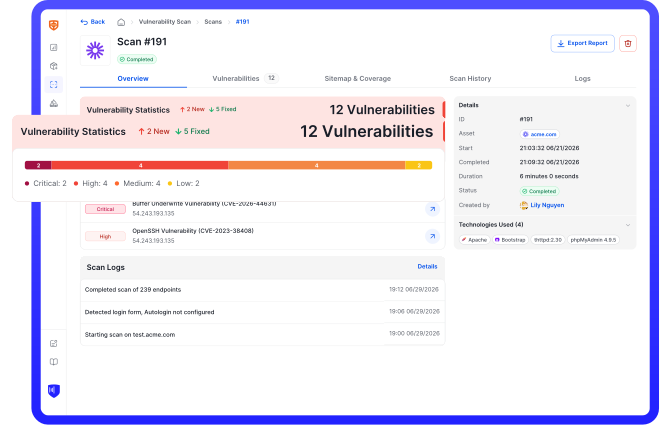
CyStack VulnScan continuously discovers assets, validates vulnerabilities, and helps security teams prioritize remediation across the organization.

Review CyStack's security rating and practical recommendations for websites and edge assets.

Explore cybersecurity research from our team of security specialists.

Browse practical cybersecurity knowledge across CyStack's articles and guides.


en