CWE-284: Improper Access Control

What is CWE-284?

MITRE CWE

The product does not restrict or incorrectly restricts access to a resource from an unauthorized actor.

The analysis could not be completed. Official CWE data remains available below.

A short verification protects the official data source and prevents automated AI abuse.

Official definition

MITRE CWE

The product does not restrict or incorrectly restricts access to a resource from an unauthorized actor.

Access control involves the use of several protection mechanisms such as: - Authentication (proving the identity of an actor) - Authorization (ensuring that a given actor can access a resource), and - Accountability (tracking of activities that were performed) When any mechanism is not applied or otherwise fails, attackers can compromise the security of the product by gaining privileges, reading sensitive information, executing commands, evading detection, etc. There are two distinct behaviors that can introduce access control weaknesses: - Specification: incorrect privileges, permissions, ownership, etc. are explicitly specified for either the user or the resource (for example, setting a password file to be world-writable, or giving administrator capabilities to a guest user). This action could be performed by the program or the administrator. - Enforcement: the mechanism contains errors that prevent it from properly enforcing the specified access control requirements (e.g., allowing the user to specify their own privileges, or allowing a syntactically-incorrect ACL to produce insecure settings). This problem occurs within the program itself, in that it does not actually enforce the intended security policy that the administrator specifies.

Detailed description

The analysis could not be completed. Official CWE data remains available below.

Characteristics

The analysis could not be completed. Official CWE data remains available below.
  • Authorization: The terms "access control" and "authorization" are often used interchangeably, although many people have distinct definitions. The CWE usage of "access control" is intended as a general term for the various mechanisms that restrict which users can access which resources, and "authorization" is more narrowly defined. It is unlikely that there will be community consensus on the use of these terms.

Modes of introduction

  • Architecture and Design
  • Implementation: REALIZATION: This weakness is caused during implementation of an architectural security tactic.
  • Operation

Common consequences

The analysis could not be completed. Official CWE data remains available below.
  • Other

    Varies by Context

Mitigations

The analysis could not be completed. Official CWE data remains available below.
  • Architecture and Design, OperationVery carefully manage the setting, management, and handling of privileges. Explicitly manage trust zones in the software.
  • Architecture and Design · Separation of PrivilegeCompartmentalize the system to have "safe" areas where trust boundaries can be unambiguously drawn. Do not allow sensitive data to go outside of the trust boundary and always be careful when interfacing with a compartment outside of the safe area. Ensure that appropriate compartmentalization is built into the system design, and the compartmentalization allows for and reinforces privilege separation functionality. Architects and designers should rely on the principle of least privilege to decide the appropriate time to use privileges and the time to drop privileges.

Detection methods

The analysis could not be completed. Official CWE data remains available below.

Representative vulnerabilities

The analysis could not be completed. Official CWE data remains available below.

These examples illustrate this CWE entry and are not an exhaustive list of related vulnerabilities.

  • CVE-2023-26463Chain: IPSec VPN product uses the same variable for multiple purposes in the same function (CWE-1109), leading to incorrect access control (CWE-284) and expired pointer dereference (CWE-825)
  • CVE-2022-24985A form hosting website only checks the session authentication status for a single form, making it possible to bypass authentication when there are multiple forms
  • CVE-2022-29238Access-control setting in web-based document collaboration tool is not properly implemented by the code, which prevents listing hidden directories but does not prevent direct requests to files in those directories.
  • CVE-2022-23607Python-based HTTP library did not scope cookies to a particular domain such that "supercookies" could be sent to any domain on redirect
  • CVE-2021-21972Chain: Cloud computing virtualization platform does not require authentication for upload of a tar format file (CWE-306), then uses .. path traversal sequences (CWE-23) in the file to access unexpected files, as exploited in the wild per CISA KEV.
  • CVE-2021-37415IT management product does not perform authentication for some REST API requests, as exploited in the wild per CISA KEV.
  • CVE-2021-35033Firmware for a WiFi router uses a hard-coded password for a BusyBox shell, allowing bypass of authentication through the UART port
  • CVE-2020-10263Bluetooth speaker does not require authentication for the debug functionality on the UART port, allowing root shell access
  • CVE-2020-13927Default setting in workflow management product allows all API requests without authentication, as exploited in the wild per CISA KEV.
  • CVE-2010-4624Bulletin board applies restrictions on number of images during post creation, but does not enforce this on editing.

Sources and references

References

CWE™ Program, operated by The MITRE Corporation. Copyright © 2006–2026, The MITRE Corporation. The MITRE Corporation hereby grants you a non-exclusive, royalty-free license to use CWE for research, development, and commercial purposes. CWE Terms of Use.

Learn more

Run an in-depth assessment with complete web risk management

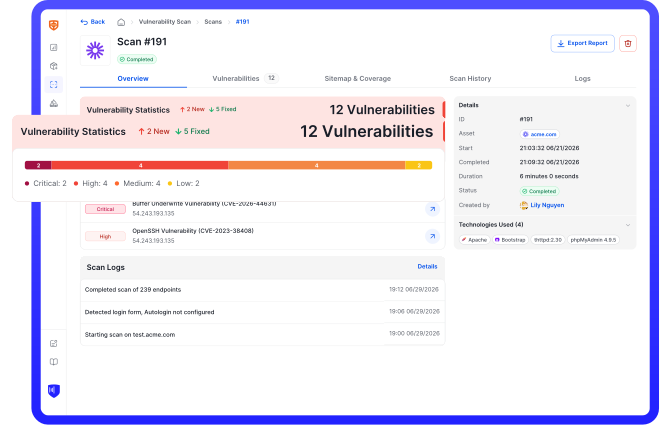
CyStack VulnScan continuously discovers assets, validates vulnerabilities, and helps security teams prioritize remediation across the organization.

Explore CyStack VulnScan
CyStack VulnScan dashboard