CWE-754: Improper Check for Unusual or Exceptional Conditions

What is CWE-754?

MITRE CWE

The product does not check or incorrectly checks for unusual or exceptional conditions that are not expected to occur frequently during day to day operation of the product.

Verify to analyze this CWE entry

A short verification protects the official data source and prevents automated AI abuse.

Official definition

MITRE CWE

The product does not check or incorrectly checks for unusual or exceptional conditions that are not expected to occur frequently during day to day operation of the product.

The programmer may assume that certain events or conditions will never occur or do not need to be worried about, such as low memory conditions, lack of access to resources due to restrictive permissions, or misbehaving clients or components. However, attackers may intentionally trigger these unusual conditions, thus violating the programmer's assumptions, possibly introducing instability, incorrect behavior, or a vulnerability. Note that this entry is not exclusively about the use of exceptions and exception handling, which are mechanisms for both checking and handling unusual or unexpected conditions.

Many functions will return some value about the success of their actions. This will alert the program whether or not to handle any errors caused by that function.

Detailed description

CyStack is analyzing this CWE entry. The page will update automatically when the bilingual analysis is ready.

Characteristics

CyStack is analyzing this CWE entry. The page will update automatically when the bilingual analysis is ready.

Modes of introduction

  • Implementation: REALIZATION: This weakness is caused during implementation of an architectural security tactic.

Common consequences

CyStack is analyzing this CWE entry. The page will update automatically when the bilingual analysis is ready.
  • Integrity, Availability

    DoS: Crash, Exit, or Restart, Unexpected State

    The data which were produced as a result of a function call could be in a bad state upon return. If the return value is not checked, then this bad data may be used in operations, possibly leading to a crash or other unintended behaviors.

Mitigations

CyStack is analyzing this CWE entry. The page will update automatically when the bilingual analysis is ready.
  • Requirements · Language SelectionUse a language that does not allow this weakness to occur or provides constructs that make this weakness easier to avoid. Choose languages with features such as exception handling that force the programmer to anticipate unusual conditions that may generate exceptions. Custom exceptions may need to be developed to handle unusual business-logic conditions. Be careful not to pass sensitive exceptions back to the user (CWE-209, CWE-248).
  • ImplementationCheck the results of all functions that return a value and verify that the value is expected.Effectiveness: HighChecking the return value of the function will typically be sufficient, however beware of race conditions (CWE-362) in a concurrent environment.
  • ImplementationIf using exception handling, catch and throw specific exceptions instead of overly-general exceptions (CWE-396, CWE-397). Catch and handle exceptions as locally as possible so that exceptions do not propagate too far up the call stack (CWE-705). Avoid unchecked or uncaught exceptions where feasible (CWE-248).Effectiveness: HighUsing specific exceptions, and ensuring that exceptions are checked, helps programmers to anticipate and appropriately handle many unusual events that could occur.
  • ImplementationEnsure that error messages only contain minimal details that are useful to the intended audience and no one else. The messages need to strike the balance between being too cryptic (which can confuse users) or being too detailed (which may reveal more than intended). The messages should not reveal the methods that were used to determine the error. Attackers can use detailed information to refine or optimize their original attack, thereby increasing their chances of success. If errors must be captured in some detail, record them in log messages, but consider what could occur if the log messages can be viewed by attackers. Highly sensitive information such as passwords should never be saved to log files. Avoid inconsistent messaging that might accidentally tip off an attacker about internal state, such as whether a user account exists or not. Exposing additional information to a potential attacker in the context of an exceptional condition can help the attacker determine what attack vectors are most likely to succeed beyond DoS.
  • Implementation · Input ValidationAssume all input is malicious. Use an "accept known good" input validation strategy, i.e., use a list of acceptable inputs that strictly conform to specifications. Reject any input that does not strictly conform to specifications, or transform it into something that does. When performing input validation, consider all potentially relevant properties, including length, type of input, the full range of acceptable values, missing or extra inputs, syntax, consistency across related fields, and conformance to business rules. As an example of business rule logic, "boat" may be syntactically valid because it only contains alphanumeric characters, but it is not valid if the input is only expected to contain colors such as "red" or "blue." Do not rely exclusively on looking for malicious or malformed inputs. This is likely to miss at least one undesirable input, especially if the code's environment changes. This can give attackers enough room to bypass the intended validation. However, denylists can be useful for detecting potential attacks or determining which inputs are so malformed that they should be rejected outright.Performing extensive input validation does not help with handling unusual conditions, but it will minimize their occurrences and will make it more difficult for attackers to trigger them.
  • Architecture and Design, ImplementationIf the program must fail, ensure that it fails gracefully (fails closed). There may be a temptation to simply let the program fail poorly in cases such as low memory conditions, but an attacker may be able to assert control before the software has fully exited. Alternately, an uncontrolled failure could cause cascading problems with other downstream components; for example, the program could send a signal to a downstream process so the process immediately knows that a problem has occurred and has a better chance of recovery.
  • Architecture and DesignUse system limits, which should help to prevent resource exhaustion. However, the product should still handle low resource conditions since they may still occur.

Detection methods

CyStack is analyzing this CWE entry. The page will update automatically when the bilingual analysis is ready.
  • Automated Static AnalysisAutomated static analysis may be useful for detecting unusual conditions involving system resources or common programming idioms, but not for violations of business rules.Effectiveness: Moderate
  • Manual Dynamic AnalysisIdentify error conditions that are not likely to occur during normal usage and trigger them. For example, run the program under low memory conditions, run with insufficient privileges or permissions, interrupt a transaction before it is completed, or disable connectivity to basic network services such as DNS. Monitor the software for any unexpected behavior. If you trigger an unhandled exception or similar error that was discovered and handled by the application's environment, it may still indicate unexpected conditions that were not handled by the application itself.

Representative vulnerabilities

CyStack is analyzing this CWE entry. The page will update automatically when the bilingual analysis is ready.

These examples illustrate this CWE entry and are not an exhaustive list of related vulnerabilities.

  • CVE-2023-49286Chain: function in web caching proxy does not correctly check a return value (CWE-253) leading to a reachable assertion (CWE-617)
  • CVE-2007-3798Unchecked return value leads to resultant integer overflow and code execution.
  • CVE-2006-4447Program does not check return value when invoking functions to drop privileges, which could leave users with higher privileges than expected by forcing those functions to fail.
  • CVE-2006-2916Program does not check return value when invoking functions to drop privileges, which could leave users with higher privileges than expected by forcing those functions to fail.

Sources and references

References

CWE™ Program, operated by The MITRE Corporation. Copyright © 2006–2026, The MITRE Corporation. The MITRE Corporation hereby grants you a non-exclusive, royalty-free license to use CWE for research, development, and commercial purposes. CWE Terms of Use.

Learn more

Run an in-depth assessment with complete web risk management

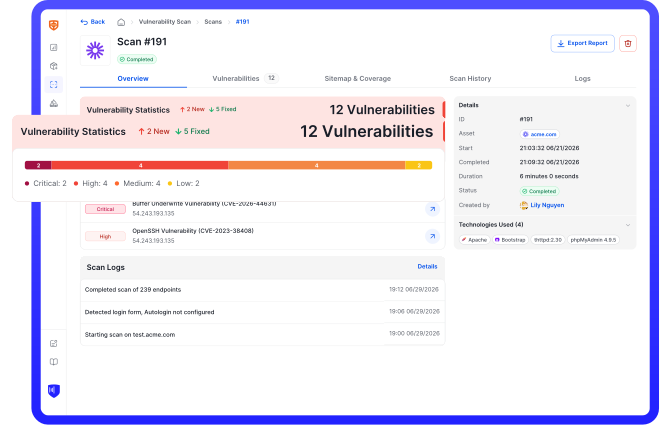
CyStack VulnScan continuously discovers assets, validates vulnerabilities, and helps security teams prioritize remediation across the organization.

Explore CyStack VulnScan
CyStack VulnScan dashboard