CWE-416: Use After Free

What is CWE-416?

MITRE CWE

The product reuses or references memory after it has been freed. At some point afterward, the memory may be allocated again and saved in another pointer, while the original pointer references a location somewhere within the new allocation. Any operations using the original pointer are no longer valid because the memory "belongs" to the code that operates on the new pointer.

Verify to analyze this CWE entry

A short verification protects the official data source and prevents automated AI abuse.

Official definition

MITRE CWE

The product reuses or references memory after it has been freed. At some point afterward, the memory may be allocated again and saved in another pointer, while the original pointer references a location somewhere within the new allocation. Any operations using the original pointer are no longer valid because the memory "belongs" to the code that operates on the new pointer.

Detailed description

CyStack is analyzing this CWE entry. The page will update automatically when the bilingual analysis is ready.

Characteristics

CyStack is analyzing this CWE entry. The page will update automatically when the bilingual analysis is ready.
  • Dangling pointer: a pointer that no longer points to valid memory, often after it has been freed
  • UAF: commonly used acronym for Use After Free
  • Use-After-Free

Modes of introduction

  • Implementation

Common consequences

CyStack is analyzing this CWE entry. The page will update automatically when the bilingual analysis is ready.
  • Integrity

    Modify Memory

    The use of previously freed memory may corrupt valid data, if the memory area in question has been allocated and used properly elsewhere.

  • Availability

    DoS: Crash, Exit, or Restart

    If chunk consolidation occurs after the use of previously freed data, the process may crash when invalid data is used as chunk information.

  • Confidentiality

    Read Memory

    Read operations on freed memory can sometimes leak sensitive information instead of causing a crash

  • Integrity, Confidentiality, Availability

    Execute Unauthorized Code or Commands

    If malicious data is entered before chunk consolidation can take place, it may be possible to take advantage of a write-what-where primitive to execute arbitrary code. If the newly allocated data happens to hold a class, in C++ for example, various function pointers may be scattered within the heap data. If one of these function pointers is overwritten with an address to valid shellcode, execution of arbitrary code can be achieved.

Mitigations

CyStack is analyzing this CWE entry. The page will update automatically when the bilingual analysis is ready.
  • Architecture and Design · Language SelectionChoose a language that provides automatic memory management.
  • Implementation · Attack Surface ReductionWhen freeing pointers, be sure to set them to NULL once they are freed. However, the utilization of multiple or complex data structures may lower the usefulness of this strategy.Effectiveness: Defense in DepthIf a bug causes an attempted access of this pointer, then a NULL dereference could still lead to a crash or other unexpected behavior, but it will reduce or eliminate the risk of code execution.

Detection methods

CyStack is analyzing this CWE entry. The page will update automatically when the bilingual analysis is ready.
  • FuzzingFuzz testing (fuzzing) is a powerful technique for generating large numbers of diverse inputs - either randomly or algorithmically - and dynamically invoking the code with those inputs. Even with random inputs, it is often capable of generating unexpected results such as crashes, memory corruption, or resource consumption. Fuzzing effectively produces repeatable test cases that clearly indicate bugs, which helps developers to diagnose the issues.Effectiveness: High
  • Automated Static AnalysisAutomated static analysis, commonly referred to as Static Application Security Testing (SAST), can find some instances of this weakness by analyzing source code (or binary/compiled code) without having to execute it. Typically, this is done by building a model of data flow and control flow, then searching for potentially-vulnerable patterns that connect "sources" (origins of input) with "sinks" (destinations where the data interacts with external components, a lower layer such as the OS, etc.)Effectiveness: High
  • Automated Dynamic AnalysisUse tools that are integrated during compilation to insert runtime error-checking mechanisms related to memory safety errors, such as AddressSanitizer (ASan) for C/C++ [REF-1518].Effectiveness: ModerateCrafted inputs are necessary to reach the code containing the error, such as generated by fuzzers. Also, these tools may reduce performance, and they only report the error condition - not the original mistake that led to the error.

Representative vulnerabilities

CyStack is analyzing this CWE entry. The page will update automatically when the bilingual analysis is ready.

These examples illustrate this CWE entry and are not an exhaustive list of related vulnerabilities.

  • CVE-2023-38160TCP/IP code for an OS has a use-after-free that can leak heap memory contents
  • CVE-2022-20141Chain: an operating system kernel has insufficent resource locking (CWE-413) leading to a use after free (CWE-416).
  • CVE-2022-2621Chain: two threads in a web browser use the same resource (CWE-366), but one of those threads can destroy the resource before the other has completed (CWE-416).
  • CVE-2021-0920Chain: mobile platform race condition (CWE-362) leading to use-after-free (CWE-416), as exploited in the wild per CISA KEV.
  • CVE-2020-6819Chain: race condition (CWE-362) leads to use-after-free (CWE-416), as exploited in the wild per CISA KEV.
  • CVE-2010-4168Use-after-free triggered by closing a connection while data is still being transmitted.
  • CVE-2010-2941Improper allocation for invalid data leads to use-after-free.
  • CVE-2010-2547certificate with a large number of Subject Alternate Names not properly handled in realloc, leading to use-after-free
  • CVE-2010-1772Timers are not disabled when a related object is deleted
  • CVE-2010-1437Access to a "dead" object that is being cleaned up
  • CVE-2010-1208object is deleted even with a non-zero reference count, and later accessed
  • CVE-2010-0629use-after-free involving request containing an invalid version number
  • CVE-2010-0378unload of an object that is currently being accessed by other functionality
  • CVE-2010-0302incorrectly tracking a reference count leads to use-after-free
  • CVE-2010-0249use-after-free related to use of uninitialized memory
  • CVE-2010-0050HTML document with incorrectly-nested tags
  • CVE-2009-3658Use after free in ActiveX object by providing a malformed argument to a method
  • CVE-2009-3616use-after-free by disconnecting during data transfer, or a message containing incorrect data types
  • CVE-2009-3553disconnect during a large data transfer causes incorrect reference count, leading to use-after-free
  • CVE-2009-2416use-after-free found by fuzzing
  • CVE-2009-1837Chain: race condition (CWE-362) from improper handling of a page transition in web client while an applet is loading (CWE-368) leads to use after free (CWE-416)
  • CVE-2009-0749realloc generates new buffer and pointer, but previous pointer is still retained, leading to use after free
  • CVE-2010-3328Use-after-free in web browser, probably resultant from not initializing memory.
  • CVE-2008-5038use-after-free when one thread accessed memory that was freed by another thread
  • CVE-2008-0077assignment of malformed values to certain properties triggers use after free
  • CVE-2006-4434mail server does not properly handle a long header.
  • CVE-2010-2753chain: integer overflow leads to use-after-free
  • CVE-2006-4997freed pointer dereference
  • CVE-2003-0813Chain: A multi-threaded race condition (CWE-367) allows attackers to cause two threads to process the same RPC request, which causes a use-after-free (CWE-416) in one thread

Sources and references

References

CWE™ Program, operated by The MITRE Corporation. Copyright © 2006–2026, The MITRE Corporation. The MITRE Corporation hereby grants you a non-exclusive, royalty-free license to use CWE for research, development, and commercial purposes. CWE Terms of Use.

Learn more

Run an in-depth assessment with complete web risk management

CyStack VulnScan continuously discovers assets, validates vulnerabilities, and helps security teams prioritize remediation across the organization.

Explore CyStack VulnScan
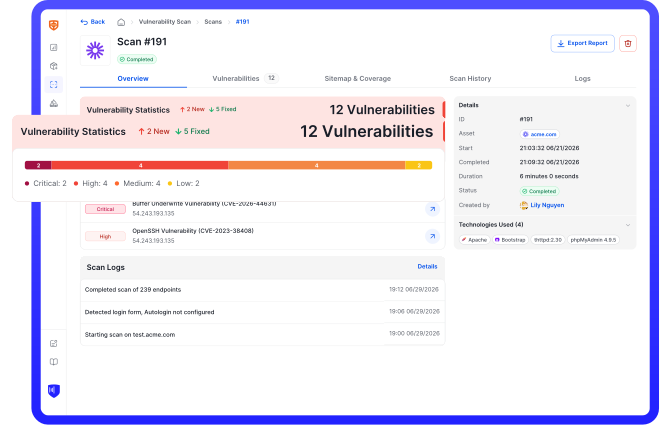
CyStack VulnScan dashboard