CWE-306: Missing Authentication for Critical Function

What is CWE-306?

MITRE CWE

The product does not perform any authentication for functionality that requires a provable user identity or consumes a significant amount of resources.

Verify to analyze this CWE entry

A short verification protects the official data source and prevents automated AI abuse.

Official definition

MITRE CWE

The product does not perform any authentication for functionality that requires a provable user identity or consumes a significant amount of resources.

Detailed description

CyStack is analyzing this CWE entry. The page will update automatically when the bilingual analysis is ready.

Characteristics

CyStack is analyzing this CWE entry. The page will update automatically when the bilingual analysis is ready.

Modes of introduction

  • Architecture and Design: OMISSION: This weakness is caused by missing a security tactic during the architecture and design phase.
  • Architecture and Design: Developers sometimes perform authentication at the primary channel, but open up a secondary channel that is assumed to be private. For example, a login mechanism may be listening on one network port, but after successful authentication, it may open up a second port where it waits for the connection, but avoids authentication because it assumes that only the authenticated party will connect to the port.
  • Operation: When migrating data to the cloud (e.g., S3 buckets, Azure blobs, Google Cloud Storage, etc.), there is a risk of losing the protections that were originally provided by hosting on internal networks. If access does not require authentication, it can be easier for attackers to access the data from anywhere on the Internet.

Common consequences

CyStack is analyzing this CWE entry. The page will update automatically when the bilingual analysis is ready.
  • Access Control, Other

    Gain Privileges or Assume Identity, Varies by Context

    Exposing critical functionality essentially provides an attacker with the privilege level of that functionality. The consequences will depend on the associated functionality, but they can range from reading or modifying sensitive data, accessing administrative or other privileged functionality, or possibly even executing arbitrary code.

Mitigations

CyStack is analyzing this CWE entry. The page will update automatically when the bilingual analysis is ready.
  • Architecture and DesignDivide the software into anonymous, normal, privileged, and administrative areas. Identify which of these areas require a proven user identity, and use a centralized authentication capability. Identify all potential communication channels, or other means of interaction with the software, to ensure that all channels are appropriately protected, including those channels that are assumed to be accessible only by authorized parties. Developers sometimes perform authentication at the primary channel, but open up a secondary channel that is assumed to be private. For example, a login mechanism may be listening on one network port, but after successful authentication, it may open up a second port where it waits for the connection, but avoids authentication because it assumes that only the authenticated party will connect to the port. In general, if the software or protocol allows a single session or user state to persist across multiple connections or channels, authentication and appropriate credential management need to be used throughout.
  • Architecture and DesignFor any security checks that are performed on the client side, ensure that these checks are duplicated on the server side, in order to avoid CWE-602. Attackers can bypass the client-side checks by modifying values after the checks have been performed, or by changing the client to remove the client-side checks entirely. Then, these modified values would be submitted to the server.
  • Architecture and DesignWhere possible, avoid implementing custom, "grow-your-own" authentication routines and consider using authentication capabilities as provided by the surrounding framework, operating system, or environment. These capabilities may avoid common weaknesses that are unique to authentication; support automatic auditing and tracking; and make it easier to provide a clear separation between authentication tasks and authorization tasks. In environments such as the World Wide Web, the line between authentication and authorization is sometimes blurred. If custom authentication routines are required instead of those provided by the server, then these routines must be applied to every single page, since these pages could be requested directly.
  • Architecture and Design · Libraries or FrameworksUse a vetted library or framework that does not allow this weakness to occur or provides constructs that make this weakness easier to avoid. For example, consider using libraries with authentication capabilities such as OpenSSL or the ESAPI Authenticator [REF-45].
  • Implementation, System Configuration, OperationWhen storing data in the cloud (e.g., S3 buckets, Azure blobs, Google Cloud Storage, etc.), use the provider's controls to require strong authentication for users who should be allowed to access the data [REF-1297] [REF-1298] [REF-1302].

Detection methods

CyStack is analyzing this CWE entry. The page will update automatically when the bilingual analysis is ready.
  • Manual AnalysisThis weakness can be detected using tools and techniques that require manual (human) analysis, such as penetration testing, threat modeling, and interactive tools that allow the tester to record and modify an active session. Specifically, manual static analysis is useful for evaluating the correctness of custom authentication mechanisms.These may be more effective than strictly automated techniques. This is especially the case with weaknesses that are related to design and business rules.
  • Automated Static AnalysisAutomated static analysis is useful for detecting commonly-used idioms for authentication. A tool may be able to analyze related configuration files, such as .htaccess in Apache web servers, or detect the usage of commonly-used authentication libraries. Generally, automated static analysis tools have difficulty detecting custom authentication schemes. In addition, the software's design may include some functionality that is accessible to any user and does not require an established identity; an automated technique that detects the absence of authentication may report false positives.Effectiveness: Limited
  • Manual Static Analysis - Binary or BytecodeAccording to SOAR [REF-1479], the following detection techniques may be useful: ``` Cost effective for partial coverage: ``` Binary / Bytecode disassembler - then use manual analysis for vulnerabilities & anomaliesEffectiveness: SOAR Partial
  • Dynamic Analysis with Automated Results InterpretationAccording to SOAR [REF-1479], the following detection techniques may be useful: ``` Cost effective for partial coverage: ``` Web Application Scanner Web Services Scanner Database ScannersEffectiveness: SOAR Partial
  • Dynamic Analysis with Manual Results InterpretationAccording to SOAR [REF-1479], the following detection techniques may be useful: ``` Cost effective for partial coverage: ``` Host Application Interface Scanner Fuzz Tester Framework-based FuzzerEffectiveness: SOAR Partial
  • Manual Static Analysis - Source CodeAccording to SOAR [REF-1479], the following detection techniques may be useful: ``` Cost effective for partial coverage: ``` Focused Manual Spotcheck - Focused manual analysis of source Manual Source Code Review (not inspections)Effectiveness: SOAR Partial
  • Automated Static Analysis - Source CodeAccording to SOAR [REF-1479], the following detection techniques may be useful: ``` Cost effective for partial coverage: ``` Source code Weakness Analyzer Context-configured Source Code Weakness AnalyzerEffectiveness: SOAR Partial
  • Architecture or Design ReviewAccording to SOAR [REF-1479], the following detection techniques may be useful: ``` Highly cost effective: ``` Inspection (IEEE 1028 standard) (can apply to requirements, design, source code, etc.) Formal Methods / Correct-By-Construction ``` Cost effective for partial coverage: ``` Attack ModelingEffectiveness: High

Representative vulnerabilities

CyStack is analyzing this CWE entry. The page will update automatically when the bilingual analysis is ready.

These examples illustrate this CWE entry and are not an exhaustive list of related vulnerabilities.

  • CVE-2024-11680File-sharing PHP product does not check if user is logged in during requests for PHP library files under an includes/ directory, allowing configuration changes, code execution, and other impacts.
  • CVE-2022-31260Chain: a digital asset management program has an undisclosed backdoor in the legacy version of a PHP script (CWE-912) that could allow an unauthenticated user to export metadata (CWE-306)
  • CVE-2022-29951TCP-based protocol in Programmable Logic Controller (PLC) has no authentication.
  • CVE-2022-29952Condition Monitor firmware uses a protocol that does not require authentication.
  • CVE-2022-30276SCADA-based protocol for bridging WAN and LAN traffic has no authentication.
  • CVE-2022-30313Safety Instrumented System uses proprietary TCP protocols with no authentication.
  • CVE-2022-30317Distributed Control System (DCS) uses a protocol that has no authentication.
  • CVE-2021-21972Chain: Cloud computing virtualization platform does not require authentication for upload of a tar format file (CWE-306), then uses .. path traversal sequences (CWE-23) in the file to access unexpected files, as exploited in the wild per CISA KEV.
  • CVE-2020-10263Bluetooth speaker does not require authentication for the debug functionality on the UART port, allowing root shell access
  • CVE-2021-23147WiFi router does not require authentication for its UART port, allowing adversaries with physical access to execute commands as root
  • CVE-2021-37415IT management product does not perform authentication for some REST API requests, as exploited in the wild per CISA KEV.
  • CVE-2020-13927Default setting in workflow management product allows all API requests without authentication, as exploited in the wild per CISA KEV.
  • CVE-2002-1810MFV. Access TFTP server without authentication and obtain configuration file with sensitive plaintext information.
  • CVE-2008-6827Agent software running at privileges does not authenticate incoming requests over an unprotected channel, allowing a Shatter" attack.
  • CVE-2004-0213Product enforces restrictions through a GUI but not through privileged APIs.
  • CVE-2020-15483monitor device allows access to physical UART debug port without authentication
  • CVE-2019-9201Programmable Logic Controller (PLC) does not have an authentication feature on its communication protocols.

Sources and references

References

CWE™ Program, operated by The MITRE Corporation. Copyright © 2006–2026, The MITRE Corporation. The MITRE Corporation hereby grants you a non-exclusive, royalty-free license to use CWE for research, development, and commercial purposes. CWE Terms of Use.

Learn more

Run an in-depth assessment with complete web risk management

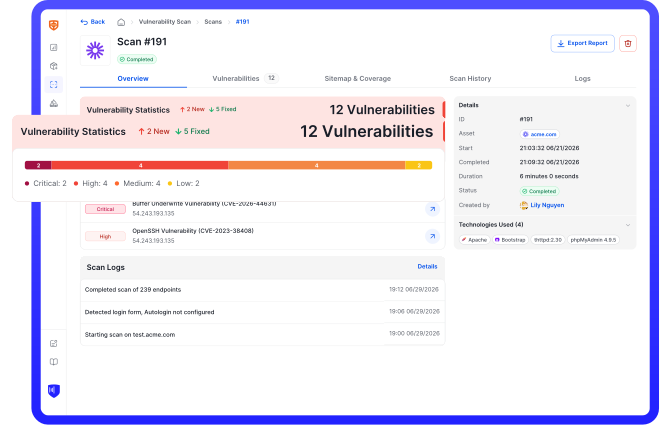
CyStack VulnScan continuously discovers assets, validates vulnerabilities, and helps security teams prioritize remediation across the organization.

Explore CyStack VulnScan
CyStack VulnScan dashboard