CWE-287: Improper Authentication

What is CWE-287?

MITRE CWE

When an actor claims to have a given identity, the product does not prove or insufficiently proves that the claim is correct.

The analysis could not be completed. Official CWE data remains available below.

A short verification protects the official data source and prevents automated AI abuse.

Official definition

MITRE CWE

When an actor claims to have a given identity, the product does not prove or insufficiently proves that the claim is correct.

Detailed description

The analysis could not be completed. Official CWE data remains available below.

Characteristics

The analysis could not be completed. Official CWE data remains available below.
  • authentification: An alternate term is "authentification", which appears to be most commonly used by people from non-English-speaking countries.
  • AuthN: "AuthN" is typically used as an abbreviation of "authentication" within the web application security community. It is also distinct from "AuthZ," which is an abbreviation of "authorization." The use of "Auth" as an abbreviation is discouraged, since it could be used for either authentication or authorization.
  • AuthC: "AuthC" is used as an abbreviation of "authentication," but it appears to used less frequently than "AuthN."

Modes of introduction

  • Architecture and Design
  • Implementation: REALIZATION: This weakness is caused during implementation of an architectural security tactic.

Common consequences

The analysis could not be completed. Official CWE data remains available below.
  • Integrity, Confidentiality, Availability, Access Control

    Read Application Data, Gain Privileges or Assume Identity, Execute Unauthorized Code or Commands

    This weakness can lead to the exposure of resources or functionality to unintended actors, possibly providing attackers with sensitive information or even execute arbitrary code.

Mitigations

The analysis could not be completed. Official CWE data remains available below.
  • Architecture and Design · Libraries or FrameworksUse an authentication framework or library such as the OWASP ESAPI Authentication feature.

Detection methods

The analysis could not be completed. Official CWE data remains available below.
  • Automated Static AnalysisAutomated static analysis is useful for detecting certain types of authentication. A tool may be able to analyze related configuration files, such as .htaccess in Apache web servers, or detect the usage of commonly-used authentication libraries. Generally, automated static analysis tools have difficulty detecting custom authentication schemes. In addition, the software's design may include some functionality that is accessible to any user and does not require an established identity; an automated technique that detects the absence of authentication may report false positives.Effectiveness: Limited
  • Manual Static AnalysisThis weakness can be detected using tools and techniques that require manual (human) analysis, such as penetration testing, threat modeling, and interactive tools that allow the tester to record and modify an active session. Manual static analysis is useful for evaluating the correctness of custom authentication mechanisms.Effectiveness: HighThese may be more effective than strictly automated techniques. This is especially the case with weaknesses that are related to design and business rules.
  • Manual Static Analysis - Binary or BytecodeAccording to SOAR [REF-1479], the following detection techniques may be useful: ``` Cost effective for partial coverage: ``` Binary / Bytecode disassembler - then use manual analysis for vulnerabilities & anomaliesEffectiveness: SOAR Partial
  • Dynamic Analysis with Automated Results InterpretationAccording to SOAR [REF-1479], the following detection techniques may be useful: ``` Cost effective for partial coverage: ``` Web Application Scanner Web Services Scanner Database ScannersEffectiveness: SOAR Partial
  • Dynamic Analysis with Manual Results InterpretationAccording to SOAR [REF-1479], the following detection techniques may be useful: ``` Cost effective for partial coverage: ``` Fuzz Tester Framework-based FuzzerEffectiveness: SOAR Partial
  • Manual Static Analysis - Source CodeAccording to SOAR [REF-1479], the following detection techniques may be useful: ``` Cost effective for partial coverage: ``` Manual Source Code Review (not inspections)Effectiveness: SOAR Partial
  • Automated Static Analysis - Source CodeAccording to SOAR [REF-1479], the following detection techniques may be useful: ``` Cost effective for partial coverage: ``` Source code Weakness Analyzer Context-configured Source Code Weakness AnalyzerEffectiveness: SOAR Partial
  • Automated Static AnalysisAccording to SOAR [REF-1479], the following detection techniques may be useful: ``` Cost effective for partial coverage: ``` Configuration CheckerEffectiveness: SOAR Partial
  • Architecture or Design ReviewAccording to SOAR [REF-1479], the following detection techniques may be useful: ``` Highly cost effective: ``` Inspection (IEEE 1028 standard) (can apply to requirements, design, source code, etc.) Formal Methods / Correct-By-ConstructionEffectiveness: High

Representative vulnerabilities

The analysis could not be completed. Official CWE data remains available below.

These examples illustrate this CWE entry and are not an exhaustive list of related vulnerabilities.

  • CVE-2024-11680File-sharing PHP product does not check if user is logged in during requests for PHP library files under an includes/ directory, allowing configuration changes, code execution, and other impacts.
  • CVE-2022-35248Chat application skips validation when Central Authentication Service (CAS) is enabled, effectively removing the second factor from two-factor authentication
  • CVE-2022-36436Python-based authentication proxy does not enforce password authentication during the initial handshake, allowing the client to bypass authentication by specifying a 'None' authentication type.
  • CVE-2022-30034Chain: Web UI for a Python RPC framework does not use regex anchors to validate user login emails (CWE-777), potentially allowing bypass of OAuth (CWE-1390).
  • CVE-2022-29951TCP-based protocol in Programmable Logic Controller (PLC) has no authentication.
  • CVE-2022-29952Condition Monitor uses a protocol that does not require authentication.
  • CVE-2022-30313Safety Instrumented System uses proprietary TCP protocols with no authentication.
  • CVE-2022-30317Distributed Control System (DCS) uses a protocol that has no authentication.
  • CVE-2022-33139SCADA system only uses client-side authentication, allowing adversaries to impersonate other users.
  • CVE-2021-3116Chain: Python-based HTTP Proxy server uses the wrong boolean operators (CWE-480) causing an incorrect comparison (CWE-697) that identifies an authN failure if all three conditions are met instead of only one, allowing bypass of the proxy authentication (CWE-1390)
  • CVE-2021-21972Chain: Cloud computing virtualization platform does not require authentication for upload of a tar format file (CWE-306), then uses .. path traversal sequences (CWE-23) in the file to access unexpected files, as exploited in the wild per CISA KEV.
  • CVE-2021-37415IT management product does not perform authentication for some REST API requests, as exploited in the wild per CISA KEV.
  • CVE-2021-35033Firmware for a WiFi router uses a hard-coded password for a BusyBox shell, allowing bypass of authentication through the UART port
  • CVE-2020-10263Bluetooth speaker does not require authentication for the debug functionality on the UART port, allowing root shell access
  • CVE-2020-13927Default setting in workflow management product allows all API requests without authentication, as exploited in the wild per CISA KEV.
  • CVE-2021-35395Stack-based buffer overflows in SFK for wifi chipset used for IoT/embedded devices, as exploited in the wild per CISA KEV.
  • CVE-2021-34523Mail server does not properly check an access token before executing a Powershell command, as exploited in the wild per CISA KEV.
  • CVE-2020-12812Chain: user is not prompted for a second authentication factor (CWE-287) when changing the case of their username (CWE-178), as exploited in the wild per CISA KEV.
  • CVE-2020-10148Authentication bypass by appending specific parameters and values to a URI, as exploited in the wild per CISA KEV.
  • CVE-2020-0688Mail server does not generate a unique key during installation, as exploited in the wild per CISA KEV.
  • CVE-2017-14623LDAP Go package allows authentication bypass using an empty password, causing an unauthenticated LDAP bind
  • CVE-2009-3421login script for guestbook allows bypassing authentication by setting a "login_ok" parameter to 1.
  • CVE-2009-2382admin script allows authentication bypass by setting a cookie value to "LOGGEDIN".
  • CVE-2009-1048VOIP product allows authentication bypass using 127.0.0.1 in the Host header.
  • CVE-2009-2213product uses default "Allow" action, instead of default deny, leading to authentication bypass.
  • CVE-2009-2168chain: redirect without exit (CWE-698) leads to resultant authentication bypass.
  • CVE-2009-3107product does not restrict access to a listening port for a critical service, allowing authentication to be bypassed.
  • CVE-2009-1596product does not properly implement a security-related configuration setting, allowing authentication bypass.
  • CVE-2009-2422authentication routine returns "nil" instead of "false" in some situations, allowing authentication bypass using an invalid username.
  • CVE-2009-3232authentication update script does not properly handle when admin does not select any authentication modules, allowing authentication bypass.
  • CVE-2009-3231use of LDAP authentication with anonymous binds causes empty password to result in successful authentication
  • CVE-2005-3435product authentication succeeds if user-provided MD5 hash matches the hash in its database; this can be subjected to replay attacks.
  • CVE-2005-0408chain: product generates predictable MD5 hashes using a constant value combined with username, allowing authentication bypass.

Sources and references

References

CWE™ Program, operated by The MITRE Corporation. Copyright © 2006–2026, The MITRE Corporation. The MITRE Corporation hereby grants you a non-exclusive, royalty-free license to use CWE for research, development, and commercial purposes. CWE Terms of Use.

Learn more

Run an in-depth assessment with complete web risk management

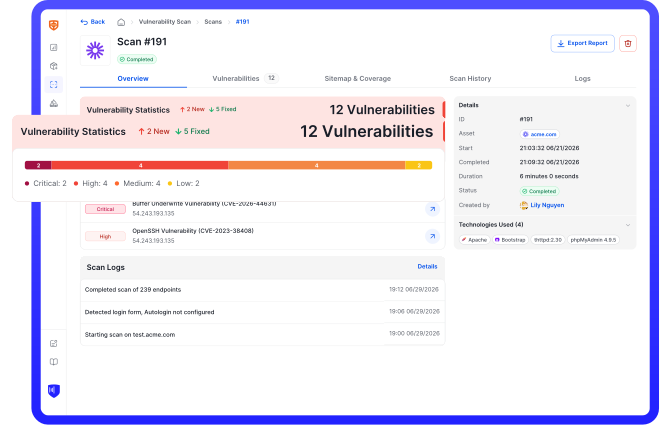
CyStack VulnScan continuously discovers assets, validates vulnerabilities, and helps security teams prioritize remediation across the organization.

Explore CyStack VulnScan
CyStack VulnScan dashboard