chiminh.hungyen.gov.vn
CỔNG THÔNG TIN ĐIỆN TỬ XÃ CHÍ MINH - TỈNH HƯNG YÊN
NHIỆM VỤ, QUYỀN HẠN CỦA ỦY BAN NHÂN DÂN TỈNH
 Industry
- Law and Government / Government
- Origin
- Vietnam
- Global rank
- #135,711
- Rank in Vietnam
- #2,694
 Vietnam
 Updated at

en
CỔNG THÔNG TIN ĐIỆN TỬ XÃ CHÍ MINH - TỈNH HƯNG YÊN
NHIỆM VỤ, QUYỀN HẠN CỦA ỦY BAN NHÂN DÂN TỈNH
IndustryOriginGlobal rankRank in VietnamUpdated at The score and grade reflect the result recorded at scan time. Review each check and its evidence for the full context.

This report summarizes the security observations recorded for chiminh.hungyen.gov.vn at scan time. Review each check and its evidence for the full context.

At assessment time, CyStack did not find chiminh.hungyen.gov.vn or related infrastructure on any scam, phishing, or malware warning list after checking 5 online reputation sources. This result reflects external observations; it does not guarantee absolute safety or verify the organization’s legal status or reputation.
Data sources
CyStack compiles scan results from its internal cybersecurity monitoring systems, including CyStack VulnScan and CyStack Threat Intelligence, together with publicly available Internet data. The assessment only observes and analyzes information already available; it does not attempt unauthorized access, test passwords, send exploit code, or change or disrupt the assessed system.
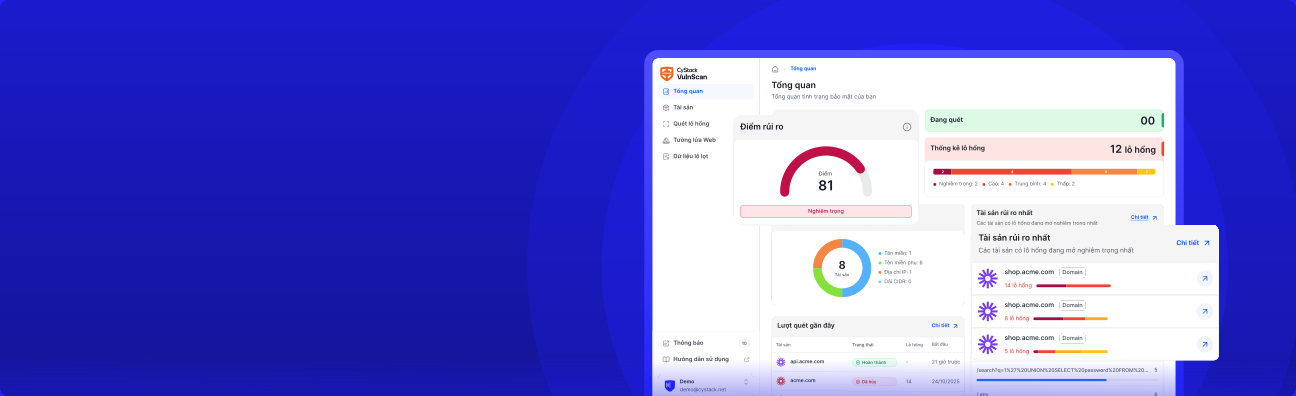
CyStack VulnScan continuously discovers assets, validates vulnerabilities, and helps security teams prioritize remediation across the enterprise.
These 3 failed checks or warnings have the greatest impact on the result for chiminh.hungyen.gov.vn.
Why it matters
Browsers trust a website only when its certificate can be traced to a recognized certificate provider. An untrusted certificate causes warnings and prevents visitors from reliably confirming the website's identity.
What to do
Install a certificate from a provider trusted by common browsers and configure the server to send every required intermediate certificate.
Evidence and check scope
Why it matters
A possible CVE match also appears in the CISA Known Exploited Vulnerabilities (KEV) catalog, which means attackers have used that vulnerability in real incidents. The match is urgent to investigate, but the installed software still needs to be confirmed as affected.
What to do
Verify the installed product immediately and follow the CISA and vendor instructions for mitigation, patching, or upgrading if it is affected.
Why it matters
The Secure attribute prevents a browser from sending a cookie over unencrypted HTTP. Without it, session or authentication data may be exposed to someone observing the network.
What to do
Set Secure on every session, authentication, and other sensitive cookie served by the HTTPS application.
Evidence and check scope
Each public IP is grouped with its open services, identified products and any CVEs that may apply to the observed version.
 14.225.68.52
 Nginx11 potential CVEsNginx
Evidence and check scope
16 additional evidence fields are not shown here.
Nginx is a web server that can also be used as a reverse proxy, load balancer, mail proxy and HTTP cache.
nginx.org/enPotential CVEs for this product
The HTTP/2 protocol allows a denial of service (server resource consumption) because request cancellation can reset many streams quickly, as exploited in the wild in August through October 2023.
NvdA security issue in nginx resolver was identified, which might allow an attacker who is able to forge UDP packets from the DNS server to cause 1-byte memory overwrite, resulting in worker process crash or potential other impact.
Nvdnginx before versions 1.15.6 and 1.14.1 has a vulnerability in the implementation of HTTP/2 that can allow for excessive memory consumption. This issue affects nginx compiled with the ngx_http_v2_module (not compiled by default) if the 'http2' option of the 'listen' directive is used in a configuration file.
Nvdnginx before versions 1.15.6 and 1.14.1 has a vulnerability in the implementation of HTTP/2 that can allow for excessive CPU usage. This issue affects nginx compiled with the ngx_http_v2_module (not compiled by default) if the 'http2' option of the 'listen' directive is used in a configuration file.
NvdSome HTTP/2 implementations are vulnerable to window size manipulation and stream prioritization manipulation, potentially leading to a denial of service. The attacker requests a large amount of data from a specified resource over multiple streams. They manipulate window size and stream priority to force the server to queue the data in 1-byte chunks. Depending on how efficiently this data is queued, this can consume excess CPU, memory, or both.
NvdSome HTTP/2 implementations are vulnerable to resource loops, potentially leading to a denial of service. The attacker creates multiple request streams and continually shuffles the priority of the streams in a way that causes substantial churn to the priority tree. This can consume excess CPU.
NvdALPACA is an application layer protocol content confusion attack, exploiting TLS servers implementing different protocols but using compatible certificates, such as multi-domain or wildcard certificates. A MiTM attacker having access to victim's traffic at the TCP/IP layer can redirect traffic from one subdomain to another, resulting in a valid TLS session. This breaks the authentication of TLS and cross-protocol attacks may be possible where the behavior of one protocol service may compromise the other at the application layer.
NvdSome HTTP/2 implementations are vulnerable to a header leak, potentially leading to a denial of service. The attacker sends a stream of headers with a 0-length header name and 0-length header value, optionally Huffman encoded into 1-byte or greater headers. Some implementations allocate memory for these headers and keep the allocation alive until the session dies. This can consume excess memory.
Nvdnginx before versions 1.15.6, 1.14.1 has a vulnerability in the ngx_http_mp4_module, which might allow an attacker to cause infinite loop in a worker process, cause a worker process crash, or might result in worker process memory disclosure by using a specially crafted mp4 file. The issue only affects nginx if it is built with the ngx_http_mp4_module (the module is not built by default) and the .mp4. directive is used in the configuration file. Further, the attack is only possible if an attacker is able to trigger processing of a specially crafted mp4 file with the ngx_http_mp4_module.
NvdNGINX before 1.17.7, with certain error_page configurations, allows HTTP request smuggling, as demonstrated by the ability of an attacker to read unauthorized web pages in environments where NGINX is being fronted by a load balancer.
NvdWhen multiple server blocks are configured to share the same IP address and port, an attacker can use session resumption to bypass client certificate authentication requirements on these servers. This vulnerability arises when TLS Session Tickets https://nginx.org/en/docs/http/ngx_http_ssl_module.html#ssl_session_ticket_key are used and/or the SSL session cache https://nginx.org/en/docs/http/ngx_http_ssl_module.html#ssl_session_cache are used in the default server and the default server is performing client certificate authentication. Note: Software versions which have reached End of Technical Support (EoTS) are not evaluated.
NvdNginxB BootstrapD
 DataTables+711 potential CVEsNginxReverse Proxies · Web Servers1.14.011 potential CVEsKEVCVSS 7.7
Nginx is a web server that can also be used as a reverse proxy, load balancer, mail proxy and HTTP cache.
Potential CVEs for this product
The HTTP/2 protocol allows a denial of service (server resource consumption) because request cancellation can reset many streams quickly, as exploited in the wild in August through October 2023.
NvdA security issue in nginx resolver was identified, which might allow an attacker who is able to forge UDP packets from the DNS server to cause 1-byte memory overwrite, resulting in worker process crash or potential other impact.
Nvdnginx before versions 1.15.6 and 1.14.1 has a vulnerability in the implementation of HTTP/2 that can allow for excessive memory consumption. This issue affects nginx compiled with the ngx_http_v2_module (not compiled by default) if the 'http2' option of the 'listen' directive is used in a configuration file.
Nvdnginx before versions 1.15.6 and 1.14.1 has a vulnerability in the implementation of HTTP/2 that can allow for excessive CPU usage. This issue affects nginx compiled with the ngx_http_v2_module (not compiled by default) if the 'http2' option of the 'listen' directive is used in a configuration file.
NvdSome HTTP/2 implementations are vulnerable to window size manipulation and stream prioritization manipulation, potentially leading to a denial of service. The attacker requests a large amount of data from a specified resource over multiple streams. They manipulate window size and stream priority to force the server to queue the data in 1-byte chunks. Depending on how efficiently this data is queued, this can consume excess CPU, memory, or both.
NvdSome HTTP/2 implementations are vulnerable to resource loops, potentially leading to a denial of service. The attacker creates multiple request streams and continually shuffles the priority of the streams in a way that causes substantial churn to the priority tree. This can consume excess CPU.
NvdALPACA is an application layer protocol content confusion attack, exploiting TLS servers implementing different protocols but using compatible certificates, such as multi-domain or wildcard certificates. A MiTM attacker having access to victim's traffic at the TCP/IP layer can redirect traffic from one subdomain to another, resulting in a valid TLS session. This breaks the authentication of TLS and cross-protocol attacks may be possible where the behavior of one protocol service may compromise the other at the application layer.
NvdSome HTTP/2 implementations are vulnerable to a header leak, potentially leading to a denial of service. The attacker sends a stream of headers with a 0-length header name and 0-length header value, optionally Huffman encoded into 1-byte or greater headers. Some implementations allocate memory for these headers and keep the allocation alive until the session dies. This can consume excess memory.
Nvdnginx before versions 1.15.6, 1.14.1 has a vulnerability in the ngx_http_mp4_module, which might allow an attacker to cause infinite loop in a worker process, cause a worker process crash, or might result in worker process memory disclosure by using a specially crafted mp4 file. The issue only affects nginx if it is built with the ngx_http_mp4_module (the module is not built by default) and the .mp4. directive is used in the configuration file. Further, the attack is only possible if an attacker is able to trigger processing of a specially crafted mp4 file with the ngx_http_mp4_module.
NvdNGINX before 1.17.7, with certain error_page configurations, allows HTTP request smuggling, as demonstrated by the ability of an attacker to read unauthorized web pages in environments where NGINX is being fronted by a load balancer.
NvdWhen multiple server blocks are configured to share the same IP address and port, an attacker can use session resumption to bypass client certificate authentication requirements on these servers. This vulnerability arises when TLS Session Tickets https://nginx.org/en/docs/http/ngx_http_ssl_module.html#ssl_session_ticket_key are used and/or the SSL session cache https://nginx.org/en/docs/http/ngx_http_ssl_module.html#ssl_session_cache are used in the default server and the default server is performing client certificate authentication. Note: Software versions which have reached End of Technical Support (EoTS) are not evaluated.
NvdBootstrapUI FrameworksVersion not visibleBootstrap is a free and open-source CSS framework directed at responsive, mobile-first front-end web development. It contains CSS and JavaScript-based design templates for typography, forms, buttons, navigation, and other interface components.
getbootstrap.comDataTablesJavaScript LibrariesVersion not visibleDataTables is a plug-in for the jQuery Javascript library adding advanced features like pagination, instant search, themes, and more to any HTML table.
datatables.net Google AnalyticsAnalyticsVersion not visible
Google Analytics is a free web analytics service that tracks and reports website traffic.
google.com/analytics HSTSSecurityVersion not visible
HTTP Strict Transport Security (HSTS) informs browsers that the site should only be accessed using HTTPS.
www.rfc-editor.org/rfc/rfc6797#section-6.1 OWL CarouselJavaScript LibrariesVersion not visible
OWL Carousel is an enabled jQuery plugin that lets you create responsive carousel sliders.
owlcarousel2.github.io/OwlCarousel2 YouTubeVideo PlayersVersion not visible
YouTube is a video sharing service where users can create their own profile, upload videos, watch, like and comment on other videos.
www.youtube.com ZURB FoundationUI FrameworksVersion not visible
Zurb Foundation is used to prototype in the browser. Allows rapid creation of websites or applications while leveraging mobile and responsive technology. The front end framework is the collection of HTML, CSS, and Javascript containing design patterns.
foundation.zurb.com jQueryJavaScript Libraries3.7.1
jQuery is a JavaScript library which is a free, open-source software designed to simplify HTML DOM tree traversal and manipulation, as well as event handling, CSS animation, and Ajax.
jquery.com Microsoft ASP.NETWeb Frameworks4.0.30319
ASP.NET is an open-source, server-side web-application framework designed for web development to produce dynamic web pages.
www.asp.netRecently completed assessments, prioritizing websites with a similar sector, country or security grade for easier comparison.