CWE-96: Improper Neutralization of Directives in Statically Saved Code ('Static Code Injection')

What is CWE-96?

MITRE CWE

The product receives input from an upstream component, but it does not neutralize or incorrectly neutralizes code syntax before inserting the input into an executable resource, such as a library, configuration file, or template.

Verify to analyze this CWE entry

A short verification protects the official data source and prevents automated AI abuse.

Detailed description

CyStack is analyzing this CWE entry. The page will update automatically when the bilingual analysis is ready.

Characteristics

CyStack is analyzing this CWE entry. The page will update automatically when the bilingual analysis is ready.

Common consequences

CyStack is analyzing this CWE entry. The page will update automatically when the bilingual analysis is ready.

Mitigations

CyStack is analyzing this CWE entry. The page will update automatically when the bilingual analysis is ready.

Detection methods

CyStack is analyzing this CWE entry. The page will update automatically when the bilingual analysis is ready.

Representative vulnerabilities

CyStack is analyzing this CWE entry. The page will update automatically when the bilingual analysis is ready.
Official MITRE CWE dataMITRE CWE

Original source fields and evidence from the MITRE CWE record.

Official definition

MITRE CWE

The product receives input from an upstream component, but it does not neutralize or incorrectly neutralizes code syntax before inserting the input into an executable resource, such as a library, configuration file, or template.

Modes of introduction

  • Implementation: REALIZATION: This weakness is caused during implementation of an architectural security tactic.
  • Implementation: This issue is frequently found in PHP applications that allow users to set configuration variables that are stored within executable PHP files. Technically, this could also be performed in some compiled code (e.g., by byte-patching an executable), although it is highly unlikely.

Common consequences

  • Confidentiality

    Read Files or Directories, Read Application Data

    The injected code could access restricted data / files.

  • Access Control

    Bypass Protection Mechanism

    In some cases, injectable code controls authentication; this may lead to a remote vulnerability.

  • Access Control

    Gain Privileges or Assume Identity

    Injected code can access resources that the attacker is directly prevented from accessing.

  • Integrity, Confidentiality, Availability, Other

    Execute Unauthorized Code or Commands

    Code injection attacks can lead to loss of data integrity in nearly all cases as the control-plane data injected is always incidental to data recall or writing. Additionally, code injection can often result in the execution of arbitrary code.

  • Non-Repudiation

    Hide Activities

    Often the actions performed by injected control code are unlogged.

Mitigations

  • Implementation · Input ValidationAssume all input is malicious. Use an "accept known good" input validation strategy, i.e., use a list of acceptable inputs that strictly conform to specifications. Reject any input that does not strictly conform to specifications, or transform it into something that does. When performing input validation, consider all potentially relevant properties, including length, type of input, the full range of acceptable values, missing or extra inputs, syntax, consistency across related fields, and conformance to business rules. As an example of business rule logic, "boat" may be syntactically valid because it only contains alphanumeric characters, but it is not valid if the input is only expected to contain colors such as "red" or "blue." Do not rely exclusively on looking for malicious or malformed inputs. This is likely to miss at least one undesirable input, especially if the code's environment changes. This can give attackers enough room to bypass the intended validation. However, denylists can be useful for detecting potential attacks or determining which inputs are so malformed that they should be rejected outright.
  • Implementation · Output EncodingPerform proper output validation and escaping to neutralize all code syntax from data written to code files.

Detection methods

  • Automated Static AnalysisAutomated static analysis, commonly referred to as Static Application Security Testing (SAST), can find some instances of this weakness by analyzing source code (or binary/compiled code) without having to execute it. Typically, this is done by building a model of data flow and control flow, then searching for potentially-vulnerable patterns that connect "sources" (origins of input) with "sinks" (destinations where the data interacts with external components, a lower layer such as the OS, etc.)

Representative vulnerabilities

These examples illustrate this CWE entry and are not an exhaustive list of related vulnerabilities.

  • CVE-2002-0495Perl code directly injected into CGI library file from parameters to another CGI program.
  • CVE-2005-1876Direct PHP code injection into supporting template file.
  • CVE-2005-1894Direct code injection into PHP script that can be accessed by attacker.
  • CVE-2003-0395PHP code from User-Agent HTTP header directly inserted into log file implemented as PHP script.
  • CVE-2007-6652chain: execution after redirect allows non-administrator to perform static code injection.

Sources and references

CWE™ Program, operated by The MITRE Corporation. Copyright © 2006–2026, The MITRE Corporation. The MITRE Corporation hereby grants you a non-exclusive, royalty-free license to use CWE for research, development, and commercial purposes. CWE Terms of Use.

Learn more

Run an in-depth assessment with complete web risk management

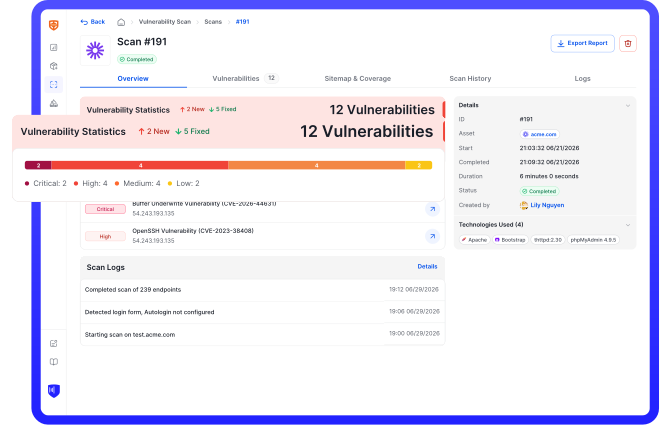
CyStack VulnScan continuously discovers assets, validates vulnerabilities, and helps security teams prioritize remediation across the organization.

Explore CyStack VulnScan
CyStack VulnScan dashboard