CWE-908: Use of Uninitialized Resource

What is CWE-908?

MITRE CWE

The product uses or accesses a resource that has not been initialized.

Verify to analyze this CWE entry

A short verification protects the official data source and prevents automated AI abuse.

Official definition

MITRE CWE

The product uses or accesses a resource that has not been initialized.

When a resource has not been properly initialized, the product may behave unexpectedly. This may lead to a crash or invalid memory access, but the consequences vary depending on the type of resource and how it is used within the product.

Detailed description

CyStack is analyzing this CWE entry. The page will update automatically when the bilingual analysis is ready.

Characteristics

CyStack is analyzing this CWE entry. The page will update automatically when the bilingual analysis is ready.

Modes of introduction

  • Implementation

Common consequences

CyStack is analyzing this CWE entry. The page will update automatically when the bilingual analysis is ready.
  • Confidentiality

    Read Memory, Read Application Data

    When reusing a resource such as memory or a program variable, the original contents of that resource may not be cleared before it is sent to an untrusted party.

  • Availability

    DoS: Crash, Exit, or Restart

    The uninitialized resource may contain values that cause program flow to change in ways that the programmer did not intend.

Mitigations

CyStack is analyzing this CWE entry. The page will update automatically when the bilingual analysis is ready.
  • ImplementationExplicitly initialize the resource before use. If this is performed through an API function or standard procedure, follow all required steps.
  • ImplementationPay close attention to complex conditionals that affect initialization, since some branches might not perform the initialization.
  • ImplementationAvoid race conditions (CWE-362) during initialization routines.
  • Build and CompilationRun or compile the product with settings that generate warnings about uninitialized variables or data.

Detection methods

CyStack is analyzing this CWE entry. The page will update automatically when the bilingual analysis is ready.
  • Automated Static AnalysisAutomated static analysis, commonly referred to as Static Application Security Testing (SAST), can find some instances of this weakness by analyzing source code (or binary/compiled code) without having to execute it. Typically, this is done by building a model of data flow and control flow, then searching for potentially-vulnerable patterns that connect "sources" (origins of input) with "sinks" (destinations where the data interacts with external components, a lower layer such as the OS, etc.)Effectiveness: High

Representative vulnerabilities

CyStack is analyzing this CWE entry. The page will update automatically when the bilingual analysis is ready.

These examples illustrate this CWE entry and are not an exhaustive list of related vulnerabilities.

  • CVE-2019-9805Chain: Creation of the packet client occurs before initialization is complete (CWE-696) resulting in a read from uninitialized memory (CWE-908), causing memory corruption.
  • CVE-2008-4197Use of uninitialized memory may allow code execution.
  • CVE-2008-2934Free of an uninitialized pointer leads to crash and possible code execution.
  • CVE-2008-0063Product does not clear memory contents when generating an error message, leading to information leak.
  • CVE-2008-0062Lack of initialization triggers NULL pointer dereference or double-free.
  • CVE-2008-0081Uninitialized variable leads to code execution in popular desktop application.
  • CVE-2008-3688Chain: Uninitialized variable leads to infinite loop.
  • CVE-2008-3475Chain: Improper initialization leads to memory corruption.
  • CVE-2005-1036Chain: Bypass of access restrictions due to improper authorization (CWE-862) of a user results from an improperly initialized (CWE-909) I/O permission bitmap
  • CVE-2008-3597Chain: game server can access player data structures before initialization has happened leading to NULL dereference
  • CVE-2009-2692Chain: Use of an unimplemented network socket operation pointing to an uninitialized handler function (CWE-456) causes a crash because of a null pointer dereference (CWE-476)
  • CVE-2009-0949Chain: improper initialization of memory can lead to NULL dereference
  • CVE-2009-3620Chain: some unprivileged ioctls do not verify that a structure has been initialized before invocation, leading to NULL dereference

Sources and references

References

CWE™ Program, operated by The MITRE Corporation. Copyright © 2006–2026, The MITRE Corporation. The MITRE Corporation hereby grants you a non-exclusive, royalty-free license to use CWE for research, development, and commercial purposes. CWE Terms of Use.

Learn more

Run an in-depth assessment with complete web risk management

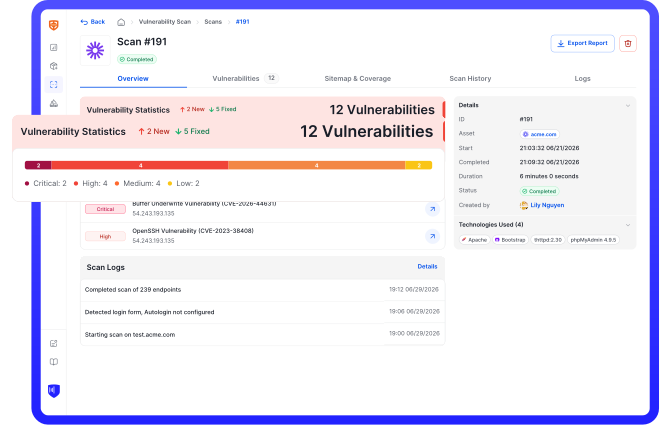
CyStack VulnScan continuously discovers assets, validates vulnerabilities, and helps security teams prioritize remediation across the organization.

Explore CyStack VulnScan
CyStack VulnScan dashboard