CWE-787: Out-of-bounds Write

What is CWE-787?

MITRE CWE

The product writes data past the end, or before the beginning, of the intended buffer.

Verify to analyze this CWE entry

A short verification protects the official data source and prevents automated AI abuse.

Official definition

MITRE CWE

The product writes data past the end, or before the beginning, of the intended buffer.

Detailed description

CyStack is analyzing this CWE entry. The page will update automatically when the bilingual analysis is ready.

Characteristics

CyStack is analyzing this CWE entry. The page will update automatically when the bilingual analysis is ready.
  • Memory Corruption: Often used to describe the consequences of writing to memory outside the bounds of a buffer, or to memory that is otherwise invalid.

Modes of introduction

  • Implementation

Common consequences

CyStack is analyzing this CWE entry. The page will update automatically when the bilingual analysis is ready.
  • Integrity

    Modify Memory, Execute Unauthorized Code or Commands

    Write operations could cause memory corruption. In some cases, an adversary can modify control data such as return addresses in order to execute unexpected code.

  • Availability

    DoS: Crash, Exit, or Restart

    Attempting to access out-of-range, invalid, or unauthorized memory could cause the product to crash.

  • Other

    Unexpected State

    Subsequent write operations can produce undefined or unexpected results.

Mitigations

CyStack is analyzing this CWE entry. The page will update automatically when the bilingual analysis is ready.
  • Requirements · Language SelectionUse a language that does not allow this weakness to occur or provides constructs that make this weakness easier to avoid. For example, many languages that perform their own memory management, such as Java and Perl, are not subject to buffer overflows. Other languages, such as Ada and C#, typically provide overflow protection, but the protection can be disabled by the programmer. Be wary that a language's interface to native code may still be subject to overflows, even if the language itself is theoretically safe.
  • Architecture and Design · Libraries or FrameworksUse a vetted library or framework that does not allow this weakness to occur or provides constructs that make this weakness easier to avoid. Examples include the Safe C String Library (SafeStr) by Messier and Viega [REF-57], and the Strsafe.h library from Microsoft [REF-56]. These libraries provide safer versions of overflow-prone string-handling functions.This is not a complete solution, since many buffer overflows are not related to strings.
  • Operation, Build and Compilation · Environment HardeningUse automatic buffer overflow detection mechanisms that are offered by certain compilers or compiler extensions. Examples include: the Microsoft Visual Studio /GS flag, Fedora/Red Hat FORTIFY_SOURCE GCC flag, StackGuard, and ProPolice, which provide various mechanisms including canary-based detection and range/index checking. D3-SFCV (Stack Frame Canary Validation) from D3FEND [REF-1334] discusses canary-based detection in detail.Effectiveness: Defense in DepthThis is not necessarily a complete solution, since these mechanisms only detect certain types of overflows. In addition, the result is still a denial of service, since the typical response is to exit the application.
  • ImplementationConsider adhering to the following rules when allocating and managing an application's memory: - Double check that the buffer is as large as specified. - When using functions that accept a number of bytes to copy, such as strncpy(), be aware that if the destination buffer size is equal to the source buffer size, it may not NULL-terminate the string. - Check buffer boundaries if accessing the buffer in a loop and make sure there is no danger of writing past the allocated space. - If necessary, truncate all input strings to a reasonable length before passing them to the copy and concatenation functions.
  • Operation, Build and Compilation · Environment HardeningRun or compile the software using features or extensions that randomly arrange the positions of a program's executable and libraries in memory. Because this makes the addresses unpredictable, it can prevent an attacker from reliably jumping to exploitable code. Examples include Address Space Layout Randomization (ASLR) [REF-58] [REF-60] and Position-Independent Executables (PIE) [REF-64]. Imported modules may be similarly realigned if their default memory addresses conflict with other modules, in a process known as "rebasing" (for Windows) and "prelinking" (for Linux) [REF-1332] using randomly generated addresses. ASLR for libraries cannot be used in conjunction with prelink since it would require relocating the libraries at run-time, defeating the whole purpose of prelinking. For more information on these techniques see D3-SAOR (Segment Address Offset Randomization) from D3FEND [REF-1335].Effectiveness: Defense in DepthThese techniques do not provide a complete solution. For instance, exploits frequently use a bug that discloses memory addresses in order to maximize reliability of code execution [REF-1337]. It has also been shown that a side-channel attack can bypass ASLR [REF-1333].
  • Operation · Environment HardeningUse a CPU and operating system that offers Data Execution Protection (using hardware NX or XD bits) or the equivalent techniques that simulate this feature in software, such as PaX [REF-60] [REF-61]. These techniques ensure that any instruction executed is exclusively at a memory address that is part of the code segment. For more information on these techniques see D3-PSEP (Process Segment Execution Prevention) from D3FEND [REF-1336].Effectiveness: Defense in DepthThis is not a complete solution, since buffer overflows could be used to overwrite nearby variables to modify the software's state in dangerous ways. In addition, it cannot be used in cases in which self-modifying code is required. Finally, an attack could still cause a denial of service, since the typical response is to exit the application.
  • ImplementationReplace unbounded copy functions with analogous functions that support length arguments, such as strcpy with strncpy. Create these if they are not available.Effectiveness: ModerateThis approach is still susceptible to calculation errors, including issues such as off-by-one errors (CWE-193) and incorrectly calculating buffer lengths (CWE-131).

Detection methods

CyStack is analyzing this CWE entry. The page will update automatically when the bilingual analysis is ready.
  • Automated Static AnalysisThis weakness can often be detected using automated static analysis tools. Many modern tools use data flow analysis or constraint-based techniques to minimize the number of false positives. Automated static analysis generally does not account for environmental considerations when reporting out-of-bounds memory operations. This can make it difficult for users to determine which warnings should be investigated first. For example, an analysis tool might report buffer overflows that originate from command line arguments in a program that is not expected to run with setuid or other special privileges.Effectiveness: HighDetection techniques for buffer-related errors are more mature than for most other weakness types.
  • Automated Dynamic AnalysisThis weakness can be detected using dynamic tools and techniques that interact with the software using large test suites with many diverse inputs, such as fuzz testing (fuzzing), robustness testing, and fault injection. The software's operation may slow down, but it should not become unstable, crash, or generate incorrect results.
  • Automated Dynamic AnalysisUse tools that are integrated during compilation to insert runtime error-checking mechanisms related to memory safety errors, such as AddressSanitizer (ASan) for C/C++ [REF-1518].Effectiveness: ModerateCrafted inputs are necessary to reach the code containing the error, such as generated by fuzzers. Also, these tools may reduce performance, and they only report the error condition - not the original mistake that led to the error.

Representative vulnerabilities

CyStack is analyzing this CWE entry. The page will update automatically when the bilingual analysis is ready.

These examples illustrate this CWE entry and are not an exhaustive list of related vulnerabilities.

  • CVE-2025-27363Font rendering library does not properly handle assigning a signed short value to an unsigned long (CWE-195), leading to an integer wraparound (CWE-190), causing too small of a buffer (CWE-131), leading to an out-of-bounds write (CWE-787).
  • CVE-2023-1017The reference implementation code for a Trusted Platform Module does not implement length checks on data, allowing for an attacker to write 2 bytes past the end of a buffer.
  • CVE-2021-21220Chain: insufficient input validation (CWE-20) in browser allows heap corruption (CWE-787), as exploited in the wild per CISA KEV.
  • CVE-2021-28664GPU kernel driver allows memory corruption because a user can obtain read/write access to read-only pages, as exploited in the wild per CISA KEV.
  • CVE-2020-17087Chain: integer truncation (CWE-197) causes small buffer allocation (CWE-131) leading to out-of-bounds write (CWE-787) in kernel pool, as exploited in the wild per CISA KEV.
  • CVE-2020-1054Out-of-bounds write in kernel-mode driver, as exploited in the wild per CISA KEV.
  • CVE-2020-0041Escape from browser sandbox using out-of-bounds write due to incorrect bounds check, as exploited in the wild per CISA KEV.
  • CVE-2020-0968Memory corruption in web browser scripting engine, as exploited in the wild per CISA KEV.
  • CVE-2020-0022chain: mobile phone Bluetooth implementation does not include offset when calculating packet length (CWE-682), leading to out-of-bounds write (CWE-787)
  • CVE-2019-1010006Chain: compiler optimization (CWE-733) removes or modifies code used to detect integer overflow (CWE-190), allowing out-of-bounds write (CWE-787).
  • CVE-2009-1532malformed inputs cause accesses of uninitialized or previously-deleted objects, leading to memory corruption
  • CVE-2009-0269chain: -1 value from a function call was intended to indicate an error, but is used as an array index instead.
  • CVE-2002-2227Unchecked length of SSLv2 challenge value leads to buffer underflow.
  • CVE-2007-4580Buffer underflow from a small size value with a large buffer (length parameter inconsistency, CWE-130)
  • CVE-2007-4268Chain: integer signedness error (CWE-195) passes signed comparison, leading to heap overflow (CWE-122)
  • CVE-2009-2550Classic stack-based buffer overflow in media player using a long entry in a playlist
  • CVE-2009-2403Heap-based buffer overflow in media player using a long entry in a playlist

Sources and references

References

CWE™ Program, operated by The MITRE Corporation. Copyright © 2006–2026, The MITRE Corporation. The MITRE Corporation hereby grants you a non-exclusive, royalty-free license to use CWE for research, development, and commercial purposes. CWE Terms of Use.

Learn more

Run an in-depth assessment with complete web risk management

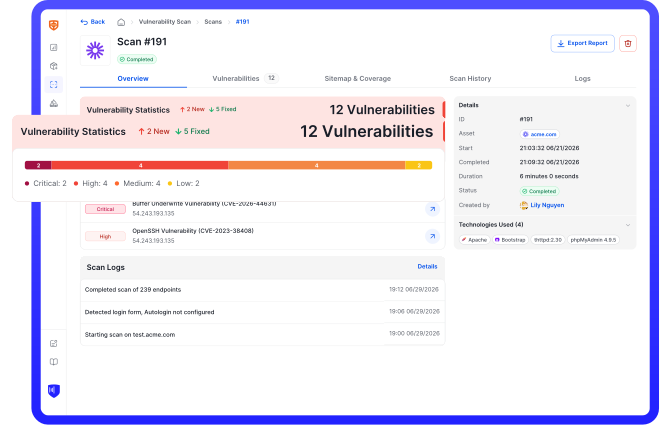
CyStack VulnScan continuously discovers assets, validates vulnerabilities, and helps security teams prioritize remediation across the organization.

Explore CyStack VulnScan
CyStack VulnScan dashboard