CWE-502: Deserialization of Untrusted Data

What is CWE-502?

MITRE CWE

The product deserializes untrusted data without sufficiently ensuring that the resulting data will be valid.

Verify to analyze this CWE entry

A short verification protects the official data source and prevents automated AI abuse.

Official definition

MITRE CWE

The product deserializes untrusted data without sufficiently ensuring that the resulting data will be valid.

Serialization and deserialization refer to the process of taking program-internal object-related data, packaging it in a way that allows the data to be externally stored or transferred ("serialization"), then extracting the serialized data to reconstruct the original object ("deserialization").

Detailed description

CyStack is analyzing this CWE entry. The page will update automatically when the bilingual analysis is ready.

Characteristics

CyStack is analyzing this CWE entry. The page will update automatically when the bilingual analysis is ready.
  • Marshaling/Marshalling, Unmarshaling/Unmarshalling: Marshaling and unmarshaling are effectively synonyms for serialization and deserialization, respectively.
  • Pickling, Unpickling: In Python, the "pickle" functionality is used to perform serialization and deserialization.
  • PHP Object Injection: Some PHP application researchers use this term when attacking unsafe use of the unserialize() function; but it is also used for CWE-915.

Modes of introduction

  • Architecture and Design: OMISSION: This weakness is caused by missing a security tactic during the architecture and design phase.
  • Implementation

Common consequences

CyStack is analyzing this CWE entry. The page will update automatically when the bilingual analysis is ready.
  • Integrity

    Modify Application Data, Unexpected State

    Attackers can modify unexpected objects or data that was assumed to be safe from modification. Deserialized data or code could be modified without using the provided accessor functions, or unexpected functions could be invoked.

  • Availability

    DoS: Resource Consumption (CPU)

    If a function is making an assumption on when to terminate, based on a sentry in a string, it could easily never terminate.

  • Other

    Varies by Context

    The consequences can vary widely, because it depends on which objects or methods are being deserialized, and how they are used. Making an assumption that the code in the deserialized object is valid is dangerous and can enable exploitation. One example is attackers using gadget chains to perform unauthorized actions, such as generating a shell.

Mitigations

CyStack is analyzing this CWE entry. The page will update automatically when the bilingual analysis is ready.
  • Architecture and Design, ImplementationIf available, use the signing/sealing features of the programming language to assure that deserialized data has not been tainted. For example, a hash-based message authentication code (HMAC) could be used to ensure that data has not been modified.
  • ImplementationWhen deserializing data, populate a new object rather than just deserializing. The result is that the data flows through safe input validation and that the functions are safe.
  • ImplementationExplicitly define a final object() to prevent deserialization.
  • Architecture and Design, ImplementationMake fields transient to protect them from deserialization. An attempt to serialize and then deserialize a class containing transient fields will result in NULLs where the transient data should be. This is an excellent way to prevent time, environment-based, or sensitive variables from being carried over and used improperly.
  • ImplementationAvoid having unnecessary types or gadgets (a sequence of instances and method invocations that can self-execute during the deserialization process, often found in libraries) available that can be leveraged for malicious ends. This limits the potential for unintended or unauthorized types and gadgets to be leveraged by the attacker. Add only acceptable classes to an allowlist. Note: new gadgets are constantly being discovered, so this alone is not a sufficient mitigation.
  • Architecture and Design, ImplementationEmploy cryptography of the data or code for protection. However, it's important to note that it would still be client-side security. This is risky because if the client is compromised then the security implemented on the client (the cryptography) can be bypassed.
  • Operation · FirewallUse an application firewall that can detect attacks against this weakness. It can be beneficial in cases in which the code cannot be fixed (because it is controlled by a third party), as an emergency prevention measure while more comprehensive software assurance measures are applied, or to provide defense in depth [REF-1481].Effectiveness: ModerateAn application firewall might not cover all possible input vectors. In addition, attack techniques might be available to bypass the protection mechanism, such as using malformed inputs that can still be processed by the component that receives those inputs. Depending on functionality, an application firewall might inadvertently reject or modify legitimate requests. Finally, some manual effort may be required for customization.

Detection methods

CyStack is analyzing this CWE entry. The page will update automatically when the bilingual analysis is ready.
  • Automated Static AnalysisAutomated static analysis, commonly referred to as Static Application Security Testing (SAST), can find some instances of this weakness by analyzing source code (or binary/compiled code) without having to execute it. Typically, this is done by building a model of data flow and control flow, then searching for potentially-vulnerable patterns that connect "sources" (origins of input) with "sinks" (destinations where the data interacts with external components, a lower layer such as the OS, etc.)Effectiveness: High

Representative vulnerabilities

CyStack is analyzing this CWE entry. The page will update automatically when the bilingual analysis is ready.

These examples illustrate this CWE entry and are not an exhaustive list of related vulnerabilities.

  • CVE-2024-37052insecure deserialization in platform for managing AI/ML applications and models allows code execution via a crafted pickled object in a model file
  • CVE-2024-37288deserialization of untrusted YAML data in dashboard for data query and visualization of Elasticsearch data
  • CVE-2024-9314PHP object injection in WordPress plugin for AI-based SEO
  • CVE-2019-12799chain: bypass of untrusted deserialization issue (CWE-502) by using an assumed-trusted class (CWE-183)
  • CVE-2015-8103Deserialization issue in commonly-used Java library allows remote execution.
  • CVE-2015-4852Deserialization issue in commonly-used Java library allows remote execution.
  • CVE-2013-1465Use of PHP unserialize function on untrusted input allows attacker to modify application configuration.
  • CVE-2012-3527Use of PHP unserialize function on untrusted input in content management system might allow code execution.
  • CVE-2012-0911Use of PHP unserialize function on untrusted input in content management system allows code execution using a crafted cookie value.
  • CVE-2012-0911Content management system written in PHP allows unserialize of arbitrary objects, possibly allowing code execution.
  • CVE-2011-2520Python script allows local users to execute code via pickled data.
  • CVE-2012-4406Unsafe deserialization using pickle in a Python script.
  • CVE-2003-0791Web browser allows execution of native methods via a crafted string to a JavaScript function that deserializes the string.

Sources and references

References

CWE™ Program, operated by The MITRE Corporation. Copyright © 2006–2026, The MITRE Corporation. The MITRE Corporation hereby grants you a non-exclusive, royalty-free license to use CWE for research, development, and commercial purposes. CWE Terms of Use.

Learn more

Run an in-depth assessment with complete web risk management

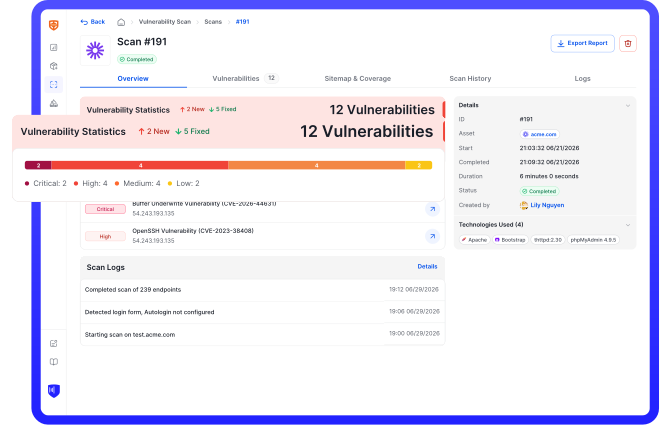
CyStack VulnScan continuously discovers assets, validates vulnerabilities, and helps security teams prioritize remediation across the organization.

Explore CyStack VulnScan
CyStack VulnScan dashboard