CWE-470: Use of Externally-Controlled Input to Select Classes or Code ('Unsafe Reflection')

What is CWE-470?

MITRE CWE

The product uses external input with reflection to select which classes or code to use, but it does not sufficiently prevent the input from selecting improper classes or code.

Verify to analyze this CWE entry

A short verification protects the official data source and prevents automated AI abuse.

Official definition

MITRE CWE

The product uses external input with reflection to select which classes or code to use, but it does not sufficiently prevent the input from selecting improper classes or code.

If the product uses external inputs to determine which class to instantiate or which method to invoke, then an attacker could supply values to select unexpected classes or methods. If this occurs, then the attacker could create control flow paths that were not intended by the developer. These paths could bypass authentication or access control checks, or otherwise cause the product to behave in an unexpected manner. This situation becomes a doomsday scenario if the attacker can upload files into a location that appears on the product's classpath (CWE-427) or add new entries to the product's classpath (CWE-426). Under either of these conditions, the attacker can use reflection to introduce new, malicious behavior into the product.

Detailed description

CyStack is analyzing this CWE entry. The page will update automatically when the bilingual analysis is ready.

Characteristics

CyStack is analyzing this CWE entry. The page will update automatically when the bilingual analysis is ready.
  • Reflection Injection

Modes of introduction

  • Architecture and Design
  • Implementation

Common consequences

CyStack is analyzing this CWE entry. The page will update automatically when the bilingual analysis is ready.
  • Integrity, Confidentiality, Availability, Other

    Execute Unauthorized Code or Commands, Alter Execution Logic

    The attacker might be able to execute code that is not directly accessible to the attacker. Alternately, the attacker could call unexpected code in the wrong place or the wrong time, possibly modifying critical system state.

  • Availability, Other

    DoS: Crash, Exit, or Restart, Other

    The attacker might be able to use reflection to call the wrong code, possibly with unexpected arguments that violate the API (CWE-227). This could cause the product to exit or hang.

  • Confidentiality

    Read Application Data

    By causing the wrong code to be invoked, the attacker might be able to trigger a runtime error that leaks sensitive information in the error message, such as CWE-536.

Mitigations

CyStack is analyzing this CWE entry. The page will update automatically when the bilingual analysis is ready.
  • Architecture and DesignRefactor your code to avoid using reflection.
  • Architecture and DesignDo not use user-controlled inputs to select and load classes or code.
  • ImplementationApply strict input validation by using allowlists or indirect selection to ensure that the user is only selecting allowable classes or code.

Detection methods

CyStack is analyzing this CWE entry. The page will update automatically when the bilingual analysis is ready.
  • Automated Static AnalysisAutomated static analysis, commonly referred to as Static Application Security Testing (SAST), can find some instances of this weakness by analyzing source code (or binary/compiled code) without having to execute it. Typically, this is done by building a model of data flow and control flow, then searching for potentially-vulnerable patterns that connect "sources" (origins of input) with "sinks" (destinations where the data interacts with external components, a lower layer such as the OS, etc.)Effectiveness: High

Representative vulnerabilities

CyStack is analyzing this CWE entry. The page will update automatically when the bilingual analysis is ready.

These examples illustrate this CWE entry and are not an exhaustive list of related vulnerabilities.

  • CVE-2018-1000613Cryptography API uses unsafe reflection when deserializing a private key
  • CVE-2004-2331Database system allows attackers to bypass sandbox restrictions by using the Reflection API.

Sources and references

References

CWE™ Program, operated by The MITRE Corporation. Copyright © 2006–2026, The MITRE Corporation. The MITRE Corporation hereby grants you a non-exclusive, royalty-free license to use CWE for research, development, and commercial purposes. CWE Terms of Use.

Learn more

Run an in-depth assessment with complete web risk management

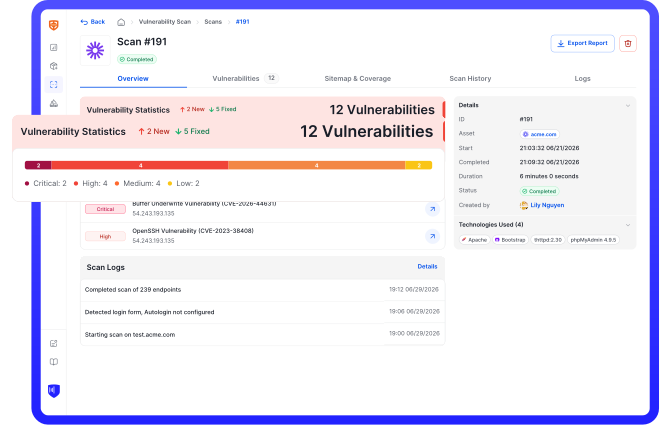
CyStack VulnScan continuously discovers assets, validates vulnerabilities, and helps security teams prioritize remediation across the organization.

Explore CyStack VulnScan
CyStack VulnScan dashboard