CWE-441: Unintended Proxy or Intermediary ('Confused Deputy')

What is CWE-441?

MITRE CWE

The product receives a request, message, or directive from an upstream component, but the product does not sufficiently preserve the original source of the request before forwarding the request to an external actor that is outside of the product's control sphere. This causes the product to appear to be the source of the request, leading it to act as a proxy or other intermediary between the upstream component and the external actor.

Verify to analyze this CWE entry

A short verification protects the official data source and prevents automated AI abuse.

Official definition

MITRE CWE

The product receives a request, message, or directive from an upstream component, but the product does not sufficiently preserve the original source of the request before forwarding the request to an external actor that is outside of the product's control sphere. This causes the product to appear to be the source of the request, leading it to act as a proxy or other intermediary between the upstream component and the external actor.

If an attacker cannot directly contact a target, but the product has access to the target, then the attacker can send a request to the product and have it be forwarded to the target. The request would appear to be coming from the product's system, not the attacker's system. As a result, the attacker can bypass access controls (such as firewalls) or hide the source of malicious requests, since the requests would not be coming directly from the attacker. Since proxy functionality and message-forwarding often serve a legitimate purpose, this issue only becomes a vulnerability when: - The product runs with different privileges or on a different system, or otherwise has different levels of access than the upstream component; - The attacker is prevented from making the request directly to the target; and - The attacker can create a request that the proxy does not explicitly intend to be forwarded on the behalf of the requester. Such a request might point to an unexpected hostname, port number, hardware IP, or service. Or, the request might be sent to an allowed service, but the request could contain disallowed directives, commands, or resources.

Detailed description

CyStack is analyzing this CWE entry. The page will update automatically when the bilingual analysis is ready.

Characteristics

CyStack is analyzing this CWE entry. The page will update automatically when the bilingual analysis is ready.
  • Confused Deputy: This weakness is sometimes referred to as the "Confused deputy" problem, in which an attacker misuses the authority of one victim (the "confused deputy") to use that victim's legitimate (restricted) capabilities to target another victim.

Modes of introduction

  • Architecture and Design: REALIZATION: This weakness is caused during implementation of an architectural security tactic.

Common consequences

CyStack is analyzing this CWE entry. The page will update automatically when the bilingual analysis is ready.
  • Non-Repudiation, Access Control

    Gain Privileges or Assume Identity, Hide Activities, Execute Unauthorized Code or Commands

Mitigations

CyStack is analyzing this CWE entry. The page will update automatically when the bilingual analysis is ready.
  • Architecture and DesignEnforce the use of strong mutual authentication mechanism between the two parties.
  • Architecture and DesignWhenever a product is an intermediary or proxy for transactions between two other components, the proxy core should not drop the identity of the initiator of the transaction. The immutability of the identity of the initiator must be maintained and should be forwarded all the way to the target.

Detection methods

CyStack is analyzing this CWE entry. The page will update automatically when the bilingual analysis is ready.
  • Automated Static AnalysisAutomated static analysis, commonly referred to as Static Application Security Testing (SAST), can find some instances of this weakness by analyzing source code (or binary/compiled code) without having to execute it. Typically, this is done by building a model of data flow and control flow, then searching for potentially-vulnerable patterns that connect "sources" (origins of input) with "sinks" (destinations where the data interacts with external components, a lower layer such as the OS, etc.)Effectiveness: High

Representative vulnerabilities

CyStack is analyzing this CWE entry. The page will update automatically when the bilingual analysis is ready.

These examples illustrate this CWE entry and are not an exhaustive list of related vulnerabilities.

  • CVE-1999-0017FTP bounce attack. The design of the protocol allows an attacker to modify the PORT command to cause the FTP server to connect to other machines besides the attacker's.
  • CVE-1999-0168RPC portmapper could redirect service requests from an attacker to another entity, which thinks the requests came from the portmapper.
  • CVE-2005-0315FTP server does not ensure that the IP address in a PORT command is the same as the FTP user's session, allowing port scanning by proxy.
  • CVE-2002-1484Web server allows attackers to request a URL from another server, including other ports, which allows proxied scanning.
  • CVE-2004-2061CGI script accepts and retrieves incoming URLs.
  • CVE-2001-1484Bounce attack allows access to TFTP from trusted side.
  • CVE-2010-1637Web-based mail program allows internal network scanning using a modified POP3 port number.
  • CVE-2009-0037URL-downloading library automatically follows redirects to file:// and scp:// URLs

Sources and references

References

CWE™ Program, operated by The MITRE Corporation. Copyright © 2006–2026, The MITRE Corporation. The MITRE Corporation hereby grants you a non-exclusive, royalty-free license to use CWE for research, development, and commercial purposes. CWE Terms of Use.

Learn more

Run an in-depth assessment with complete web risk management

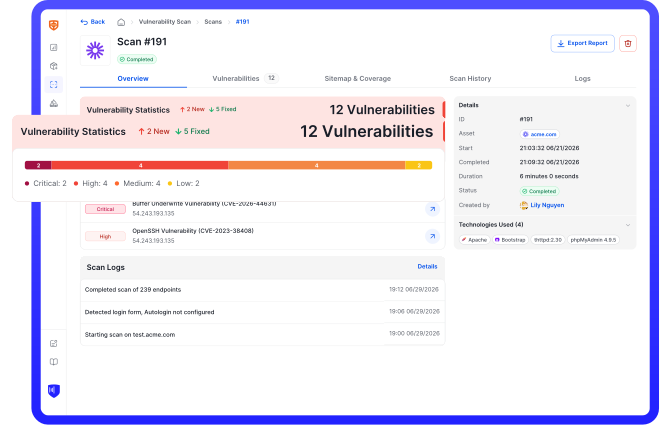
CyStack VulnScan continuously discovers assets, validates vulnerabilities, and helps security teams prioritize remediation across the organization.

Explore CyStack VulnScan
CyStack VulnScan dashboard