CWE-244: Improper Clearing of Heap Memory Before Release ('Heap Inspection')

What is CWE-244?

MITRE CWE

Using realloc() to resize buffers that store sensitive information can leave the sensitive information exposed to attack, because it is not removed from memory.

Verify to analyze this CWE entry

A short verification protects the official data source and prevents automated AI abuse.

Official definition

MITRE CWE

Using realloc() to resize buffers that store sensitive information can leave the sensitive information exposed to attack, because it is not removed from memory.

When sensitive data such as a password or an encryption key is not removed from memory, it could be exposed to an attacker using a "heap inspection" attack that reads the sensitive data using memory dumps or other methods. The realloc() function is commonly used to increase the size of a block of allocated memory. This operation often requires copying the contents of the old memory block into a new and larger block. This operation leaves the contents of the original block intact but inaccessible to the program, preventing the program from being able to scrub sensitive data from memory. If an attacker can later examine the contents of a memory dump, the sensitive data could be exposed.

Detailed description

CyStack is analyzing this CWE entry. The page will update automatically when the bilingual analysis is ready.

Characteristics

CyStack is analyzing this CWE entry. The page will update automatically when the bilingual analysis is ready.

Modes of introduction

  • Implementation

Common consequences

CyStack is analyzing this CWE entry. The page will update automatically when the bilingual analysis is ready.
  • Confidentiality, Other

    Read Memory, Other

    Be careful using vfork() and fork() in security sensitive code. The process state will not be cleaned up and will contain traces of data from past use.

Mitigations

CyStack is analyzing this CWE entry. The page will update automatically when the bilingual analysis is ready.

Detection methods

CyStack is analyzing this CWE entry. The page will update automatically when the bilingual analysis is ready.
  • Automated Static AnalysisAutomated static analysis, commonly referred to as Static Application Security Testing (SAST), can find some instances of this weakness by analyzing source code (or binary/compiled code) without having to execute it. Typically, this is done by building a model of data flow and control flow, then searching for potentially-vulnerable patterns that connect "sources" (origins of input) with "sinks" (destinations where the data interacts with external components, a lower layer such as the OS, etc.)

Representative vulnerabilities

CyStack is analyzing this CWE entry. The page will update automatically when the bilingual analysis is ready.

These examples illustrate this CWE entry and are not an exhaustive list of related vulnerabilities.

  • CVE-2019-3733Cryptography library does not clear heap memory before release

Sources and references

References

CWE™ Program, operated by The MITRE Corporation. Copyright © 2006–2026, The MITRE Corporation. The MITRE Corporation hereby grants you a non-exclusive, royalty-free license to use CWE for research, development, and commercial purposes. CWE Terms of Use.

Learn more

Run an in-depth assessment with complete web risk management

CyStack VulnScan continuously discovers assets, validates vulnerabilities, and helps security teams prioritize remediation across the organization.

Explore CyStack VulnScan
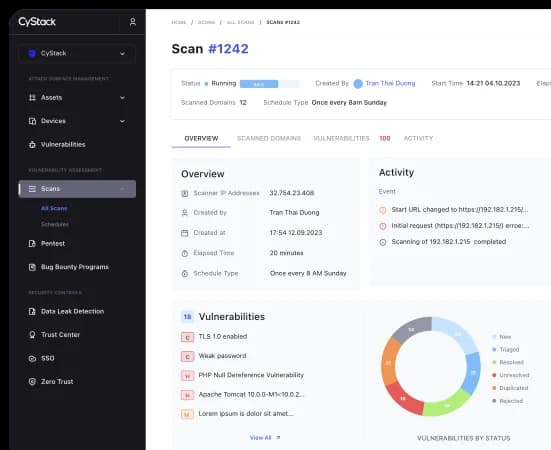
CyStack VulnScan dashboard