CWE-190: Integer Overflow or Wraparound

What is CWE-190?

MITRE CWE

The product performs a calculation that can produce an integer overflow or wraparound when the logic assumes that the resulting value will always be larger than the original value. This occurs when an integer value is incremented to a value that is too large to store in the associated representation. When this occurs, the value may become a very small or negative number.

Verify to analyze this CWE entry

A short verification protects the official data source and prevents automated AI abuse.

Official definition

MITRE CWE

The product performs a calculation that can produce an integer overflow or wraparound when the logic assumes that the resulting value will always be larger than the original value. This occurs when an integer value is incremented to a value that is too large to store in the associated representation. When this occurs, the value may become a very small or negative number.

Detailed description

CyStack is analyzing this CWE entry. The page will update automatically when the bilingual analysis is ready.

Characteristics

CyStack is analyzing this CWE entry. The page will update automatically when the bilingual analysis is ready.
  • Overflow: The terms "overflow" and "wraparound" are used interchangeably by some people, but they can have more precise distinctions by others. See Terminology Notes.
  • Wraparound: The terms "overflow" and "wraparound" are used interchangeably by some people, but they can have more precise distinctions by others. See Terminology Notes.
  • wrap, wrap-around, wrap around: Alternate spellings of "wraparound"

Modes of introduction

  • Implementation: This weakness may become security critical when determining the offset or size in behaviors such as memory allocation, copying, and concatenation.

Common consequences

CyStack is analyzing this CWE entry. The page will update automatically when the bilingual analysis is ready.
  • Availability

    DoS: Crash, Exit, or Restart, DoS: Resource Consumption (Memory), DoS: Instability

    This weakness can generally lead to undefined behavior and therefore crashes. When the calculated result is used for resource allocation, this weakness can cause too many (or too few) resources to be allocated, possibly enabling crashes if the product requests more resources than can be provided.

  • Integrity

    Modify Memory

    If the value in question is important to data (as opposed to flow), simple data corruption has occurred. Also, if the overflow/wraparound results in other conditions such as buffer overflows, further memory corruption may occur.

  • Confidentiality, Availability, Access Control

    Execute Unauthorized Code or Commands, Bypass Protection Mechanism

    This weakness can sometimes trigger buffer overflows, which can be used to execute arbitrary code. This is usually outside the scope of the product's implicit security policy.

  • Availability, Other

    Alter Execution Logic, DoS: Crash, Exit, or Restart, DoS: Resource Consumption (CPU)

    If the overflow/wraparound occurs in a loop index variable, this could cause the loop to terminate at the wrong time - too early, too late, or not at all (i.e., infinite loops). With too many iterations, some loops could consume too many resources such as memory, file handles, etc., possibly leading to a crash or other DoS.

  • Access Control

    Bypass Protection Mechanism

    If integer values are used in security-critical decisions, such as calculating quotas or allocation limits, integer overflows can be used to cause an incorrect security decision.

Mitigations

CyStack is analyzing this CWE entry. The page will update automatically when the bilingual analysis is ready.
  • RequirementsEnsure that all protocols are strictly defined, such that all out-of-bounds behavior can be identified simply, and require strict conformance to the protocol.
  • Requirements · Language SelectionUse a language that does not allow this weakness to occur or provides constructs that make this weakness easier to avoid. If possible, choose a language or compiler that performs automatic bounds checking.
  • Architecture and Design · Libraries or FrameworksUse a vetted library or framework that does not allow this weakness to occur or provides constructs that make this weakness easier to avoid [REF-1482]. Use libraries or frameworks that make it easier to handle numbers without unexpected consequences. Examples include safe integer handling packages such as SafeInt (C++) or IntegerLib (C or C++). [REF-106]
  • Implementation · Input ValidationPerform input validation on any numeric input by ensuring that it is within the expected range. Enforce that the input meets both the minimum and maximum requirements for the expected range. Use unsigned integers where possible. This makes it easier to perform validation for integer overflows. When signed integers are required, ensure that the range check includes minimum values as well as maximum values.
  • ImplementationUnderstand the programming language's underlying representation and how it interacts with numeric calculation (CWE-681). Pay close attention to byte size discrepancies, precision, signed/unsigned distinctions, truncation, conversion and casting between types, "not-a-number" calculations, and how the language handles numbers that are too large or too small for its underlying representation. [REF-7] Also be careful to account for 32-bit, 64-bit, and other potential differences that may affect the numeric representation.
  • Architecture and DesignFor any security checks that are performed on the client side, ensure that these checks are duplicated on the server side, in order to avoid CWE-602. Attackers can bypass the client-side checks by modifying values after the checks have been performed, or by changing the client to remove the client-side checks entirely. Then, these modified values would be submitted to the server.
  • Implementation · Compilation or Build HardeningExamine compiler warnings closely and eliminate problems with potential security implications, such as signed / unsigned mismatch in memory operations, or use of uninitialized variables. Even if the weakness is rarely exploitable, a single failure may lead to the compromise of the entire system.

Detection methods

CyStack is analyzing this CWE entry. The page will update automatically when the bilingual analysis is ready.
  • Automated Static AnalysisThis weakness can often be detected using automated static analysis tools. Many modern tools use data flow analysis or constraint-based techniques to minimize the number of false positives.Effectiveness: High
  • Black BoxSometimes, evidence of this weakness can be detected using dynamic tools and techniques that interact with the product using large test suites with many diverse inputs, such as fuzz testing (fuzzing), robustness testing, and fault injection. The product's operation may slow down, but it should not become unstable, crash, or generate incorrect results.Effectiveness: ModerateWithout visibility into the code, black box methods may not be able to sufficiently distinguish this weakness from others, requiring follow-up manual methods to diagnose the underlying problem.
  • Manual AnalysisThis weakness can be detected using tools and techniques that require manual (human) analysis, such as penetration testing, threat modeling, and interactive tools that allow the tester to record and modify an active session. Specifically, manual static analysis is useful for evaluating the correctness of allocation calculations. This can be useful for detecting overflow conditions (CWE-190) or similar weaknesses that might have serious security impacts on the program.Effectiveness: HighThese may be more effective than strictly automated techniques. This is especially the case with weaknesses that are related to design and business rules.
  • Automated Static Analysis - Binary or BytecodeAccording to SOAR [REF-1479], the following detection techniques may be useful: ``` Highly cost effective: ``` Bytecode Weakness Analysis - including disassembler + source code weakness analysis Binary Weakness Analysis - including disassembler + source code weakness analysisEffectiveness: High
  • Dynamic Analysis with Manual Results InterpretationAccording to SOAR [REF-1479], the following detection techniques may be useful: ``` Cost effective for partial coverage: ``` Fuzz Tester Framework-based FuzzerEffectiveness: SOAR Partial
  • Manual Static Analysis - Source CodeAccording to SOAR [REF-1479], the following detection techniques may be useful: ``` Cost effective for partial coverage: ``` Manual Source Code Review (not inspections)Effectiveness: SOAR Partial
  • Automated Static Analysis - Source CodeAccording to SOAR [REF-1479], the following detection techniques may be useful: ``` Highly cost effective: ``` Source code Weakness Analyzer Context-configured Source Code Weakness AnalyzerEffectiveness: High
  • Architecture or Design ReviewAccording to SOAR [REF-1479], the following detection techniques may be useful: ``` Highly cost effective: ``` Formal Methods / Correct-By-Construction ``` Cost effective for partial coverage: ``` Inspection (IEEE 1028 standard) (can apply to requirements, design, source code, etc.)Effectiveness: High

Representative vulnerabilities

CyStack is analyzing this CWE entry. The page will update automatically when the bilingual analysis is ready.

These examples illustrate this CWE entry and are not an exhaustive list of related vulnerabilities.

  • CVE-2025-46687Chain: Javascript engine code does not perform a length check (CWE-1284) leading to integer overflow (CWE-190) causing allocation of smaller buffer than expected (CWE-131) resulting in a heap-based buffer overflow (CWE-122)
  • CVE-2025-27363Font rendering library does not properly handle assigning a signed short value to an unsigned long (CWE-195), leading to an integer wraparound (CWE-190), causing too small of a buffer (CWE-131), leading to an out-of-bounds write (CWE-787).
  • CVE-2021-43537Chain: in a web browser, an unsigned 64-bit integer is forcibly cast to a 32-bit integer (CWE-681) and potentially leading to an integer overflow (CWE-190). If an integer overflow occurs, this can cause heap memory corruption (CWE-122)
  • CVE-2019-19911Chain: Python library does not limit the resources used to process images that specify a very large number of bands (CWE-1284), leading to excessive memory consumption (CWE-789) or an integer overflow (CWE-190).
  • CVE-2022-0545Chain: 3D renderer has an integer overflow (CWE-190) leading to write-what-where condition (CWE-123) using a crafted image.
  • CVE-2021-30860Chain: improper input validation (CWE-20) leads to integer overflow (CWE-190) in mobile OS, as exploited in the wild per CISA KEV.
  • CVE-2021-30663Chain: improper input validation (CWE-20) leads to integer overflow (CWE-190) in mobile OS, as exploited in the wild per CISA KEV.
  • CVE-2018-10887Chain: unexpected sign extension (CWE-194) leads to integer overflow (CWE-190), causing an out-of-bounds read (CWE-125)
  • CVE-2019-1010006Chain: compiler optimization (CWE-733) removes or modifies code used to detect integer overflow (CWE-190), allowing out-of-bounds write (CWE-787).
  • CVE-2010-1866Chain: integer overflow (CWE-190) causes a negative signed value, which later bypasses a maximum-only check (CWE-839), leading to heap-based buffer overflow (CWE-122).
  • CVE-2010-2753Chain: integer overflow leads to use-after-free
  • CVE-2005-1513Chain: integer overflow in securely-coded mail program leads to buffer overflow. In 2005, this was regarded as unrealistic to exploit, but in 2020, it was rediscovered to be easier to exploit due to evolutions of the technology.
  • CVE-2002-0391Integer overflow via a large number of arguments.
  • CVE-2002-0639Integer overflow in OpenSSH as listed in the demonstrative examples.
  • CVE-2005-1141Image with large width and height leads to integer overflow.
  • CVE-2005-0102Length value of -1 leads to allocation of 0 bytes and resultant heap overflow.
  • CVE-2004-2013Length value of -1 leads to allocation of 0 bytes and resultant heap overflow.
  • CVE-2017-1000121chain: unchecked message size metadata allows integer overflow (CWE-190) leading to buffer overflow (CWE-119).
  • CVE-2013-1591Chain: an integer overflow (CWE-190) in the image size calculation causes an infinite loop (CWE-835) which sequentially allocates buffers without limits (CWE-1325) until the stack is full.

Sources and references

References

CWE™ Program, operated by The MITRE Corporation. Copyright © 2006–2026, The MITRE Corporation. The MITRE Corporation hereby grants you a non-exclusive, royalty-free license to use CWE for research, development, and commercial purposes. CWE Terms of Use.

Learn more

Run an in-depth assessment with complete web risk management

CyStack VulnScan continuously discovers assets, validates vulnerabilities, and helps security teams prioritize remediation across the organization.

Explore CyStack VulnScan
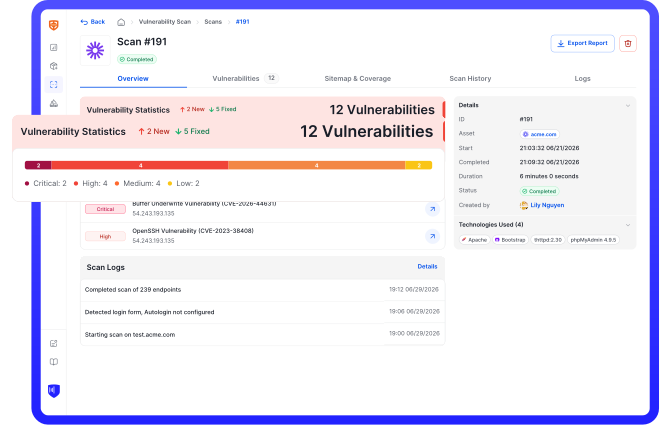
CyStack VulnScan dashboard