CWE-178: Improper Handling of Case Sensitivity

What is CWE-178?

The product does not properly account for differences in case sensitivity when accessing or determining the properties of a resource, leading to inconsistent results.

Analyzing data...

Data statistics

RELATED CVES (365 DAYS)38
ABSTRACTIONBase

Vulnerabilities mapped to CWE-178

38 vulnerabilities1,166.7% increase year over year

Vulnerabilities in CISA KEV for CWE-178

0 vulnerabilities

Official definition

ByMitre CWE

The product does not properly account for differences in case sensitivity when accessing or determining the properties of a resource, leading to inconsistent results.

Improperly handled case sensitive data can lead to several possible consequences, including:

  • case-insensitive passwords reducing the size of the key space, making brute force attacks easier

  • bypassing filters or access controls using alternate names

  • multiple interpretation errors using alternate names.

Characteristics

Modes of introduction

  • Implementation

Common consequences

ImpactScopeExplanation
Bypass Protection MechanismAccess Control

Risk mitigations

  1. Input Validation · Architecture and DesignAvoid making decisions based on names of resources (e.g. files) if those resources can have alternate names.
  2. Input Validation · ImplementationAssume all input is malicious. Use an "accept known good" input validation strategy, i.e., use a list of acceptable inputs that strictly conform to specifications. Reject any input that does not strictly conform to specifications, or transform it into something that does. When performing input validation, consider all potentially relevant properties, including length, type of input, the full range of acceptable values, missing or extra inputs, syntax, consistency across related fields, and conformance to business rules. As an example of business rule logic, "boat" may be syntactically valid because it only contains alphanumeric characters, but it is not valid if the input is only expected to contain colors such as "red" or "blue." Do not rely exclusively on looking for malicious or malformed inputs. This is likely to miss at least one undesirable input, especially if the code's environment changes. This can give attackers enough room to bypass the intended validation. However, denylists can be useful for detecting potential attacks or determining which inputs are so malformed that they should be rejected outright.
  3. Input Validation · ImplementationInputs should be decoded and canonicalized to the application's current internal representation before being validated (CWE-180). Make sure that the application does not decode the same input twice (CWE-174). Such errors could be used to bypass allowlist validation schemes by introducing dangerous inputs after they have been checked.

Representative vulnerabilities

Below are representative vulnerabilities related to this CWE, prioritized by severity.

Sources (2)

CWE™ Program, operated by The MITRE Corporation. Copyright © 2006–2026, The MITRE Corporation. The MITRE Corporation hereby grants you a non-exclusive, royalty-free license to use CWE for research, development, and commercial purposes. CWE Terms of Use.

Learn more

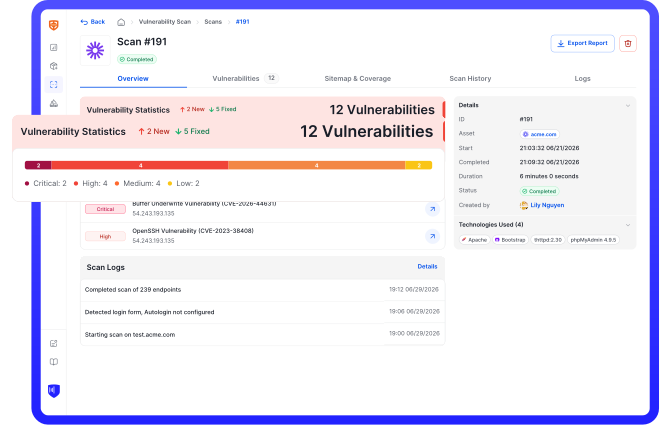
Run an in-depth assessment with complete web risk management

CyStack VulnScan continuously discovers assets, validates vulnerabilities, and helps security teams prioritize remediation across the organization.

Explore CyStack VulnScan