SQL Injection in Cisco Secure Email Gateway Enables Root Command Execution

Note: This data is for reference and cybersecurity research purposes only.CyStack advises users not to use this information for unlawful purposes.

What is CVE-2026-76461?

CVE-2026-76461 is a vulnerability classified as Improper Neutralization of Special Elements used in an SQL Command ('SQL Injection'), affecting Cisco Secure Email (affected versions: 14.0.0-698, 13.5.1-277, and other affected versions). This vulnerability is rated Critical, with a CVSS score of 9.8. This vulnerability has been observed being exploited in the wild.

Overview

Original source data

A vulnerability in the email parsing of Cisco AsyncOS Software for Cisco Secure Email Gateway could allow an unauthenticated, remote attacker to execute arbitrary commands with root privileges on the underlying operating system. This vulnerability is due to insufficient validation in the email parsing logic. An attacker could exploit this vulnerability by sending a crafted email message that contains malicious SQL statements through an affected device. A successful exploit could allow the attacker to execute arbitrary SQL statements, leading to command execution with root privileges on the underlying operating system.

Affected products and scope

Cisco Secure Email Gateway, including physical and virtual appliances, is affected regardless of device configuration. The structured record gives the default status as unknown.

  • Versions marked affected by the structured record are 13.0.0-392, 13.0.5-007, 13.5.1-277, 13.5.4-038, 14.0.0-698, 14.2.0-620, 14.2.1-020, 14.3.0-032, 15.0.0-104, 15.0.1-030, 15.0.3-002, 15.0.5-016, 15.5.0-048, 15.5.1-055, 15.5.2-018, 15.5.3-022, 15.5.4-012, 16.0.0-050, 16.0.0-054, 16.0.1-017, 16.0.2-112, 16.0.3-044, and 16.0.4-016.
  • Cisco identifies 15.5 and earlier as fixed first in 15.5.5-014.
  • Cisco identifies the 16.0 branch as fixed first in 16.0.4-302.
  • Cisco identifies the 16.5 branch as fixed first in 16.5.0-780. The structured record does not list a specific affected version for this branch, so no additional scope is inferred.
  • Cisco confirms that Secure Email and Web Manager and Secure Web Appliance are not affected.

Technical details

The flaw is in the email parsing logic of Cisco AsyncOS Software for Cisco Secure Email Gateway and is classified as CWE-89, SQL injection. An attacker can send a crafted email containing malicious SQL statements through an affected device; authentication and user interaction are not required. At a high level, the flow is: (1) the device parses attacker-controlled email content, (2) insufficient validation allows data to reach an SQL operation, and (3) arbitrary SQL statements lead to command execution with root privileges on the underlying operating system. Cisco states that both physical and virtual Secure Email Gateway appliances are in scope regardless of device configuration. Public technical detail does not identify the specific email field, internal query, or exact bridge from SQL execution to operating-system command execution.

Exploitability

The vulnerability is reachable over the network through a crafted email sent via Cisco Secure Email Gateway. The record describes exploitation as requiring no authentication, no user interaction, and low attack complexity. The record marks the vulnerability as known exploited and as having a public exploit. Cisco also reports identifying malicious activity on some Cisco Secure Email Cloud devices and directly contacting the relevant customers. The complete payload syntax and specific public exploit code are not described in the sources reviewed.

Technical impact

The flaw can allow arbitrary SQL statements and, in turn, arbitrary operating-system commands with root privileges on the appliance. Possible technical outcomes include reading or changing data, changing configuration, and disrupting email services, although the actual scope depends on the access available to the exploited process on the individual device. In a cluster, exposure of private SSH keys may allow the attacker to affect other members. Public information does not establish that every affected system experienced data access or modification, so each appliance requires its own investigation.

Business impact

Successful exploitation can give an attacker root-level command execution on an email security appliance, creating risk to data, configuration, and service availability. Control of the appliance may affect how the organization receives, analyzes, and relays email. If the compromised appliance is a cluster member, private SSH keys used for member-to-member communication may be exposed, creating a possible path to affect other members. Cisco has identified malicious activity on some Cisco Secure Email Cloud devices, so response should not be limited to software upgrades when compromise indicators are present.

Remediation

  1. Upgrade Cisco AsyncOS for Cisco Secure Email Gateway to the branch-specific fixed release: 15.5.5-014 for 15.5 and earlier, 16.0.4-302 for the 16.0 branch, or 16.5.0-780 for the 16.5 branch. Cisco recommends that systems running earlier than the 16.5 branch migrate to 16.5.0-780.
  2. No workaround addresses the vulnerability. Temporary measures do not replace upgrading to fixed software.
  3. If exploitation is suspected on a physical appliance, preserve evidence and contact Cisco TAC for investigation support.
  4. For a suspected compromised virtual appliance, record forensic information before taking further action, deploy a new virtual machine running fixed software, rebuild the configuration, renew credentials and cryptographic materials, and continue monitoring for anomalous behavior.
  5. If one cluster member is compromised, restore every member of the cluster to a secure state because private SSH keys used for member communication may have been exposed.
  6. Restrict Internet access to the appliance. If Internet access is required, allow only known trusted hosts over the ports and protocols that are necessary. Cisco states that all Cisco Secure Email Cloud devices have been upgraded to 16.5.0-780, but customers should confirm the service status for their environment with Cisco.

Detection

  1. Inventory all physical and virtual Cisco Secure Email Gateway appliances, record the installed AsyncOS release, and identify every appliance in each cluster.
  2. On every device in a cluster, review mail_logs for suspicious SQL statements. Cisco provides this example check:

cisco-esa> grep -i "COPY.*TO PROGRAM" [IronPort Text Mail Logs Log name - Default: mail_logs]

  1. Correlate the review with network and firewall logs outside the appliance. Look for unexpected uploads from the affected device to external IP addresses or downloads from malicious IP addresses.
  2. If compromise is suspected, preserve forensic information before redeploying or rebuilding the appliance. Absence of suspicious log entries does not prove safety because an attacker may remove or hide evidence.
  3. Cisco Secure Email Cloud administrators without CLI access may not be able to check these indicators independently. Coordinate with Cisco when compromise is suspected.
Sources (21)
Learn more

Run an in-depth assessment with complete web risk management

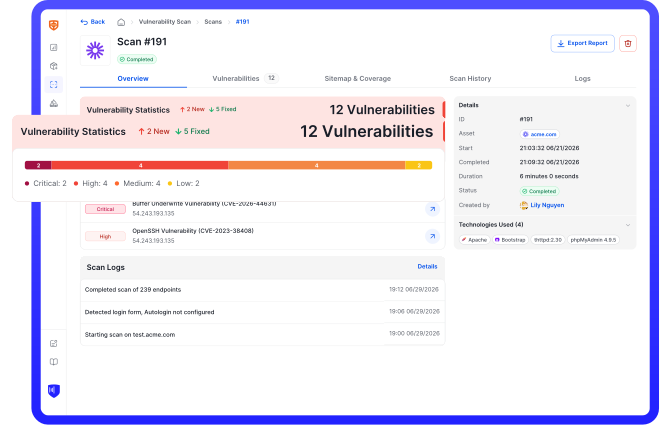
CyStack VulnScan continuously discovers assets, validates vulnerabilities, and helps security teams prioritize remediation across the organization.