www.nursing.upenn.edu
Climate Investments | University of Pennsylvania
topics
 Industry
- Science and Education / Universities and Colleges
- Origin
- United States
- Global rank
- #5,053
- Rank in United States
- #1,264
 United States
 Updated at

en
Climate Investments | University of Pennsylvania
topics
IndustryOriginGlobal rankRank in United StatesUpdated at The higher the score, the more externally observable protections the system has recorded. This page does not certify that the website is reputable, legitimate, or completely free of vulnerabilities.

As of September 20, 2026 at 23:09, www.nursing.upenn.edu has a security score of 89.2/100 (grade U: “Unrated”), but this result is provisional because some required evidence is incomplete. CyStack’s automated assessment recorded 5 issues to review after completing 40.4% of applicable checks. The website owner should address “DMARC blocking policy” first, then review the remaining items in order of impact.

CyStack did not find a confirmed network warning for www.nursing.upenn.edu or related infrastructure in the available result. This does not verify the organization, its business practices, or guarantee that the website is completely safe.
These matching email records were observed previously, but they may already have been addressed or may no longer be valid. The device count estimates infected devices associated with these email records; it is not the number of devices owned by the organization.
Frequently asked questions
A valid SSL certificate still does not prove that www.nursing.upenn.edu is safe, legitimate, or free of scam signals. For a more complete assessment, this report also checks phishing and malware, exposed email records, IPs and open ports, subdomains, technologies, and CVEs that may apply to observed versions.
HTTPS on www.nursing.upenn.edu could not be reached during this assessment, so its SSL certificate and transport encryption could not be evaluated.
Review HTTPS and certificateData sources
CyStack compiles scan results from its internal cybersecurity monitoring systems, including CyStack VulnScan and CyStack Threat Intelligence, together with publicly available Internet data. The assessment only observes and analyzes information already available; it does not attempt unauthorized access, test passwords, send exploit code, or change or disrupt the assessed system.
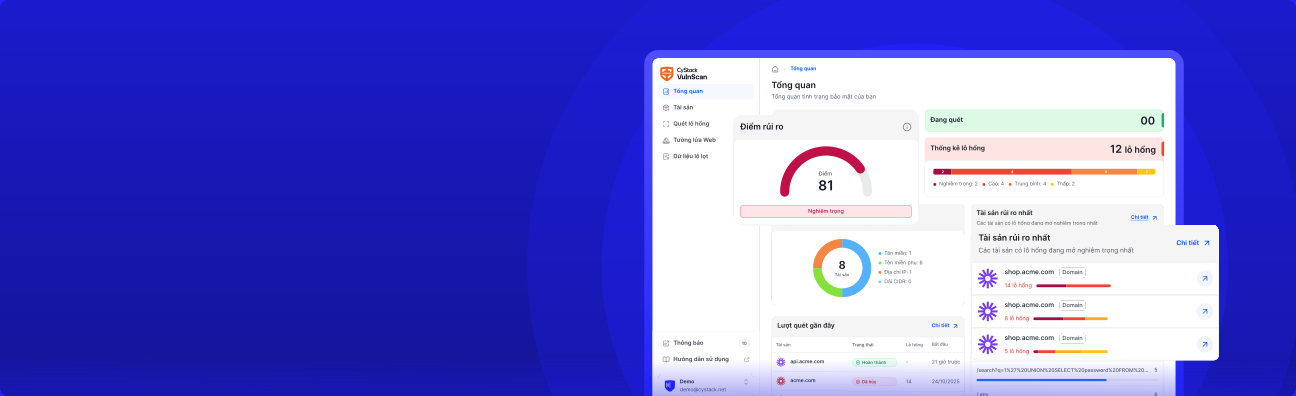
CyStack VulnScan continuously discovers assets, validates vulnerabilities, and helps security teams prioritize remediation across the enterprise.
These 3 failed checks or warnings have the greatest impact on the result for www.nursing.upenn.edu.
Why it matters
A policy of quarantine or reject tells receiving services to move suspicious mail to spam or refuse it. A monitoring-only policy (p=none) records the problem but does not ask receivers to stop spoofed mail.
What to do
After every legitimate sender passes DMARC, move gradually to quarantine and then reject, covering 100% of messages.
Evidence and check scope
References
At most 10 recent redacted records are shown to protect sensitive information.
Data provided by
This is a quick, point-in-time check from outside the organization. It can surface visible risks, but it does not replace penetration testing or an authenticated assessment.
Remove obsolete DNS names and protect non-public systems with strong authentication, MFA, network allowlists, or a VPN.
Diagnostic information
Subdomain discovery did not complete, so the current list may be incomplete.
Evidence and check scope
Evidence and check scope
References
Recently completed assessments, prioritizing websites with a similar sector, country or security grade for easier comparison.