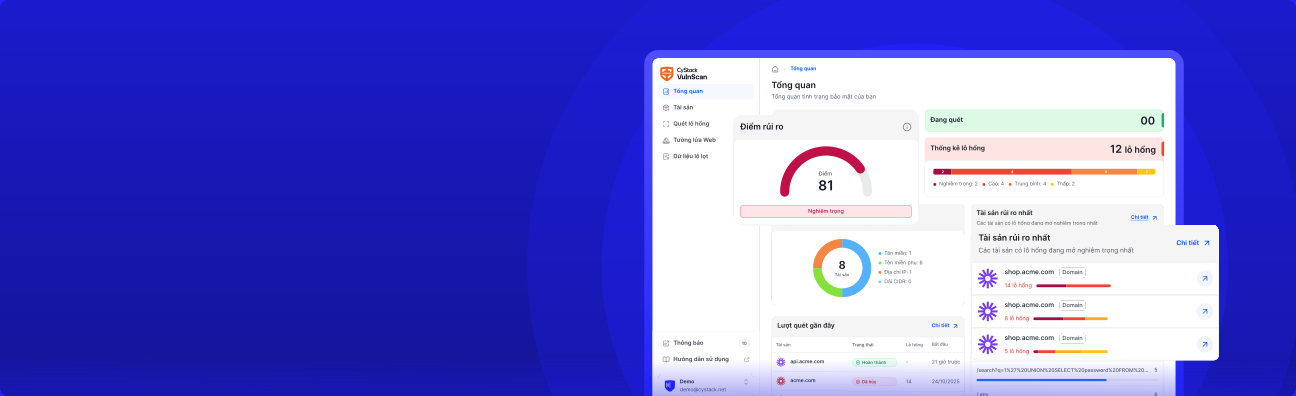
Opening the security report for www.acorn.utoronto.ca
www.acorn.utoronto.ca
Loading the security report for www.acorn.utoronto.ca
www.acorn.utoronto.ca
Is www.acorn.utoronto.ca Safe? Security Score 89.1/100 | CyStack
www.acorn.utoronto.ca
Student Web Services | University of Toronto
The University of Toronto is a globally top-ranked public research university in Toronto, Ontario, Canada.
Industry
Science and Education / Universities and Colleges
Origin
Canada
Global rank
#4,231
Rank in Canada
#124
Updated at
B89.1/100
Security level
Good
Data confidence
High
Scope checked
97.1%
The higher the score, the more externally observable protections the system has recorded. This page does not certify that the website is reputable, legitimate, or completely free of vulnerabilities.
Is the website “www.acorn.utoronto.ca” safe?
As of September 21, 2026 at 20:01, www.acorn.utoronto.ca has a security score of 89.1/100 (grade B: “Good”). CyStack’s automated assessment recorded 8 issues to review after completing 97.1% of applicable checks. The website owner should address “Allowed browser content (CSP)” first, then review the remaining items in order of impact.
Does www.acorn.utoronto.ca show known scam, phishing, or malware signals?
At assessment time, CyStack did not find www.acorn.utoronto.ca or related infrastructure on any scam, phishing, or malware warning list after checking 5 online reputation sources. This result reflects external observations; it does not guarantee absolute safety or verify the organization’s legal status or reputation.
What affects the security of www.acorn.utoronto.ca?
A valid SSL certificate still does not prove that www.acorn.utoronto.ca is safe, legitimate, or free of scam signals. For a more complete assessment, this report also checks phishing and malware, exposed email records, IPs and open ports, subdomains, technologies, and CVEs that may apply to observed versions.
Does www.acorn.utoronto.ca use HTTPS, and is its SSL certificate valid?
www.acorn.utoronto.ca used a valid SSL certificate at assessment time, valid until December 8, 2026. This status may change when the certificate expires or the server configuration changes.
Data compiled from CyStack cybersecurity monitoring systems
CyStack compiles scan results from its internal cybersecurity monitoring systems, including CyStack VulnScan and CyStack Threat Intelligence, together with publicly available Internet data. The assessment only observes and analyzes information already available; it does not attempt unauthorized access, test passwords, send exploit code, or change or disrupt the assessed system.
These 3 failed checks or warnings have the greatest impact on the result for www.acorn.utoronto.ca.
Allowed browser content (CSP)The inspected root HTML response does not include a Content-Security-Policy header.High
Why it matters
Content Security Policy (CSP) limits where scripts, styles, frames, and other browser content may come from. A strong policy reduces the impact if an attacker manages to inject content into a page.
What to do
Define only the sources the application needs, test the policy before activating it, and avoid broad wildcard (*) rules, unsafe-inline, and unsafe-eval where possible.
Scope of this check
This check only evaluates the homepage response and content that the scanner could reach. Other pages and sign-in flows may use different settings.
Potential CVEs for observed versionsFound 11 potentially applicable CVE candidate(s), including 7 high or critical candidate(s).High
Why it matters
This check compares an observed product only when a reliable version and exact CPE identity are available, using applicability records from the National Vulnerability Database (NVD). Any returned match is a lead, not confirmation: the installed software may include vendor fixes or differ from the version visible on the Internet.
What to do
Potentially sensitive subdomainsCyStack confirmed at least 1285 active DNS subdomains of utoronto.ca. 35 names may expose sensitive services; discovery was partial, so more may exist.Medium
Why it matters
Names containing admin, development, staging, VPN, database, or monitoring terms may point attackers toward valuable systems. A name alone does not prove exposure, but it identifies a surface that should be reviewed.
What to do
–
Operating system
Public infrastructure and exposed software
Each public IP is grouped with its open services, identified products and any CVEs that may apply to the observed version.
Completed testing of 58 TCP ports
52.228.120.6
2 open services16 identified products
Hosting or network providerProvider not identified
Network location–
ASN–
80HTTPAzure Application Gateway
ProductVersionPotential vulnerabilities
Azure Application Gatewayv2
Have @utoronto.ca email addresses appeared in exposed data or information-stealer (infostealer) logs?
There are currently 571 exposed email records matching the utoronto.ca domain. These records may be old or already resolved. The website owner should verify them before resetting passwords or locking related accounts.
Which public IPs, services, and ports does www.acorn.utoronto.ca expose?
The assessment observed 1 public IPs and 2 open ports for www.acorn.utoronto.ca. An open port is not the same as a vulnerability, but the website owner should keep every public service updated and appropriately restrict access.
How many subdomains of utoronto.ca have been discovered?
The assessment observed 1,285+ public subdomains of utoronto.ca. This list can reveal additional entry points such as APIs, administration systems, or test environments, but it does not mean that every subdomain is risky.
Confirm the exact installed package and read the vendor advisory. If that installation is affected, apply the vendor patch or upgrade to a fixed version.
Evidence and check scope
Data source:
nvd
Source link:
https://nvd.nist.gov/
Software items found:
9
Products ready for matching:
5
Products checked:
5
Products not checked:
4
Possible vulnerabilities:
11
Total possible vulnerabilities:
11
Possible vulnerabilities shown:
11
Possible CVE identifiers:
CVE-2025-14179, CVE-2026-14355, CVE-2026-17543, CVE-2026-6722, CVE-2026-6735, CVE-2026-7258, CVE-2026-7259, CVE-2026-7260, CVE-2026-7261, CVE-2026-7262… and 1 more
In PHP versions 8.2.* before 8.2.31, 8.3.* before 8.3.31, 8.4.* before 8.4.21, and 8.5.* before 8.5.6, the PDO Firebird driver improperly handles NUL bytes when preparing SQL queries. During token-by-token query construction, a string token containing a NUL byte is copied via strncat(), which stops at the NUL byte, dropping the closing quote and causing subsequent SQL tokens to be interpreted as part of the string. This allows SQL injection when attacker-controlled values are quoted via PDO::quote() and embedded in SQL statements.
Improper escaping of backslashes in attacker-provided parameters would allow for trivial SQL injection in PHP versions from 8.2.* before 8.2.33, from 8.3.* before 8.3.33, from 8.4.* before 8.4.24, and from 8.5.* before 8.5.9.
In PHP versions 8.2.* before 8.2.31, 8.3.* before 8.3.31, 8.4.* before 8.4.21, and 8.5.* before 8.5.6, the SOAP extension's object deduplication mechanism stores pointers to PHP objects in a global map without incrementing their reference counts. When an apache:Map node contains duplicate keys, processing the second entry overwrites the first in the temporary result map, freeing the original PHP object while its stale pointer remains in the map. A subsequent href reference to the freed node can copy the dangling pointer into the result. As PHP string allocations can reclaim the freed memory region, an attacker with control over the SOAP request body can exploit this use-after-free to achieve remote code execution.
In PHP versions 8.2.* before 8.2.31, 8.3.* before 8.3.31, 8.4.* before 8.4.21, and 8.5.* before 8.5.6, when SoapServer is configured with SOAP_PERSISTENCE_SESSION, the handler object is persisted across requests via session storage. However, in the case SOAP requests results in an error, the persistance is handled incorrectly, resulting in freeing the object while keeping a pointer to it, which may lead to use-after-free. This may lead to memory corruption, information disclosure, or process crashes, with confidentiality, integrity, and availability impact on the vulnerable system.
In PHP versions 8.2.* before 8.2.31, 8.3.* before 8.3.31, 8.4.* before 8.4.21, and 8.5.* before 8.5.6, some functions, including urldecode(), pass signed char to ctype functions (like isxdigit()). On the systems with default signed char and optimized table-lookup ctype functions - such as NetBSD - this can lead to accessing array with negative offset, which can trigger a denial of service.
In PHP versions 8.2.* before 8.2.31, 8.3.* before 8.3.31, 8.4.* before 8.4.21, and 8.5.* before 8.5.6, when a SOAP server has a typemap configured, the decoding process contains a mistake which checks the wrong variable in case of missing value element. This leads to dereferences a NULL pointer, causing a segmentation fault. This allows a remote unauthenticated attacker to crash the PHP SOAP server process, resulting in denial of service.
In PHP versions 8.2.* before 8.2.31, 8.3.* before 8.3.31, 8.4.* before 8.4.21, and 8.5.* before 8.5.6, the metaphone() function in ext/standard/metaphone.c uses a signed int variable to track the current position within the input string. If a string longer than 2,147,483,647 bytes is passed, a signed integer overflow occurs, resulting in undefined behavior. This can lead to an out-of-bounds read, causing a segmentation fault or access to unrelated memory, and may affect the availability of the PHP process.
In PHP versions 8.2.* before 8.2.31, 8.3.* before 8.3.31, 8.4.* before 8.4.21, and 8.5.* before 8.5.6, a mismatch between encoding lists in Oniguruma and mbfl leads to a NULL pointer dereference, resulting in a segmentation fault and denial of service. The vulnerability is exploitable when user-controlled input can influence the encoding passed to mb_regex_encoding().
In PHP versions 8.2.* before 8.2.31, 8.3.* before 8.3.31, 8.4.* before 8.4.21, 8.5.* before 8.5.6, due to improper sanitation of user data, it allows an attacker to compose an URL, which will cause the target to execute arbitrary JavaScript code (XSS) on the target's machine when the target is viewing the PHP-FPM status page.
Circular symbolic links in phar archives could lead to unbounded recursion, exhausting the C stack and crashing the PHP process, in PHP versions from 8.2.* before 8.2.33, from 8.3.* before 8.3.33, from 8.4.* before 8.4.24, and from 8.5.* before 8.5.9.
In PHP versions 8.2.* before 8.2.32, 8.3.* before 8.3.32, 8.4.* before 8.4.23, 8.5.* before 8.5.8, the AES-WRAP-PAD algorithm implementation in OpenSSL extension contains a buffer allocation flaw. The output buffer for the AES key-wrap-with-padding operation is sized from the plaintext length without accounting for RFC 5649 expansion. This may cause OpenSSL to write beyond allocated memory, corrupting heap metadata and triggering application abort.
Azure Edge NetworkVersion not visibleMiscellaneousVersion not visible
ConfidenceMedium
Azure Edge Network is a global network infrastructure provided by Microsoft Azure. It is designed to deliver content, applications, and services to end-users with low latency and high performance. The Azure Edge Network consists of a combination of Azure Content Delivery Network (CDN), Azure Front Door, and Azure Traffic Manager.
jQuery is a JavaScript library which is a free, open-source software designed to simplify HTML DOM tree traversal and manipulation, as well as event handling, CSS animation, and Ajax.
Query Migrate is a javascript library that allows you to preserve the compatibility of your jQuery code developed for versions of jQuery older than 1.9.
W3 Total CacheVersion not visibleCaching · WordPress PluginsVersion not visible
ConfidenceMedium
W3 Total Cache (W3TC) improves the SEO and increases website performance and reducing load times by leveraging features like content delivery network (CDN) integration and the latest best practices.
WordPress is a free and open-source content management system written in PHP and paired with a MySQL or MariaDB database. Features include a plugin architecture and a template system.


 Industry
 Canada
 Updated at