
- Sản phẩm & Dịch vụSản phẩm & Dịch vụ
- Giải phápGiải pháp
- Bảng giáBảng giá
- Công tyCông ty
- Tài liệuTài liệu

vi
vi
Chuyên mục với các bài viết hướng dẫn, nghiên cứu và phân tích chi tiết về kỹ thuật, các xu hướng công nghệ mới nhất dành cho lập trình viên.

Technical Writer

I have over 5 years of experience writing technical documentation for tech products, making them accessible and user-friendly. My focus is always on providing clear and precise information. @#@ Tôi đã có hơn 5 năm kinh nghiệm viết tài liệu kỹ thuật cho các sản phẩm công nghệ, giúp người dùng dễ dàng tiếp cận và sử dụng. Tôi luôn tập trung vào việc cung cấp thông tin chính xác và dễ hiểu.
Thảo luận (0)
Đăng nhập để thảo luận
Trong bài viết này, chúng ta sẽ cùng tìm hiểu một ví dụ về Spring ORM sử dụng Hibernate và JPA để quản lý transaction. Ta sẽ đi qua một ví dụ rất đơn giản về ứng dụng Spring với các tính năng:
Trong ví dụ này, ta sử dụng database trong bộ nhớ (in-memory). Vì vậy bạn không cần phải cài đặt bất kỳ database nào (nhưng bạn có thể thay đổi sang một database khác trong mục datasource của file spring.xml).
Đây là một ứng dụng Spring ORM chạy riêng lẻ để tối giản các dependency (phụ thuộc). Nhưng bạn luôn có thể dễ dàng chuyển đổi nó thành một dự án web hoàn chỉnh bằng cách cấu hình nó nếu bạn đã quen thuộc với Spring.
Trước hết, hãy cùng xem xét từng thành phần của dự án.
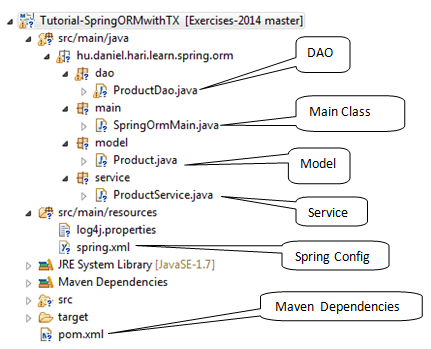
Dưới đây là file pom.xml cuối cùng chứa các dependency cho Spring ORM. Trong ví dụ này, chúng ta sử dụng Spring 4 và Hibernate 4.
<project xmlns="<https://maven.apache.org/POM/4.0.0>" xmlns:xsi="<https://www.w3.org/2001/XMLSchema-instance>" xsi:schemaLocation="<https://maven.apache.org/POM/4.0.0> <https://maven.apache.org/xsd/maven-4.0.0.xsd>"> <modelVersion>4.0.0</modelVersion><groupId>hu.daniel.hari.learn.spring</groupId> <artifactId>Tutorial-SpringORMwithTX</artifactId> <version>0.0.1-SNAPSHOT</version> <packaging>jar</packaging> <properties> <!-- Generic properties --> <project.build.sourceEncoding>UTF-8</project.build.sourceEncoding> <java.version>1.7</java.version> <!-- SPRING & HIBERNATE / JPA --> <spring.version>4.0.0.RELEASE</spring.version> <hibernate.version>4.1.9.Final</hibernate.version> </properties> <dependencies> <!-- LOG --> <dependency> <groupId>log4j</groupId> <artifactId>log4j</artifactId> <version>1.2.17</version> </dependency> <!-- Spring --> <dependency> <groupId>org.springframework</groupId> <artifactId>spring-context</artifactId> <version>${spring.version}</version> </dependency> <dependency> <groupId>org.springframework</groupId> <artifactId>spring-orm</artifactId> <version>${spring.version}</version> </dependency> <!-- JPA Vendor --> <dependency> <groupId>org.hibernate</groupId> <artifactId>hibernate-entitymanager</artifactId> <version>${hibernate.version}</version> </dependency> <!-- IN MEMORY Database and JDBC Driver --> <dependency> <groupId>hsqldb</groupId> <artifactId>hsqldb</artifactId> <version>1.8.0.7</version> </dependency> </dependencies> <build> <plugins> <plugin> <groupId>org.apache.maven.plugins</groupId> <artifactId>maven-compiler-plugin</artifactId> <version>3.1</version> <configuration> <source>${java.version}</source> <target>${java.version}</target> </configuration> </plugin> </plugins> </build></project>
spring-context và spring-orm làm các dependency của Spring.hibernate-entitymanager cho Hibernate với vai trò là một triển khai của JPA. Nó phụ thuộc vào hibernate-core, đó là lý do chúng ta không cần khai báo hibernate-core một cách tường minh trong file pom.xml. Nó sẽ được tải về dự án của chúng ta thông qua cơ chế bắc cầu dependency (transitive dependency) của Maven.Chúng ta có thể sử dụng các annotation JPA tiêu chuẩn để map (ánh xạ) trong các model bean vì Hibernate cung cấp sẵn một triển khai của JPA.
package hu.daniel.hari.learn.spring.orm.model;import javax.persistence.Entity; import javax.persistence.Id;
@Entity public class Product {
@Id private Integer id; private String name; public Product() { } public Product(Integer id, String name) { this.id = id; this.name = name; } public Integer getId() { return id; } public void setId(Integer id) { this.id = id; } public String getName() { return name; } public void setName(String name) { this.name = name; } @Override public String toString() { return "Product [id=" + id + ", name=" + name + "]"; }}
Chúng ta sử dụng các annotation @Entity và @Id của JPA để định danh POJO của ta là một Entity và để xác định khóa chính cho nó.
Chúng ta tạo một class DAO rất đơn giản cung cấp các method persist và findAll.
package hu.daniel.hari.learn.spring.orm.dao;import hu.daniel.hari.learn.spring.orm.model.Product;
import java.util.List;
import javax.persistence.EntityManager; import javax.persistence.PersistenceContext;
import org.springframework.stereotype.Component;
@Component public class ProductDao {
@PersistenceContext private EntityManager em; public void persist(Product product) { em.persist(product); } public List<Product> findAll() { return em.createQuery("SELECT p FROM Product p").getResultList(); }}
@Component là một annotation của Spring, cho Spring container biết rằng chúng ta có thể sử dụng class này thông qua Spring IoC (Dependency Injection).@PersistenceContext của JPA để yêu cầu dependency injection một EntityManager. Spring sẽ inject (chèn) một thực thể EntityManager phù hợp dựa theo cấu hình trong spring.xml.Class service đơn giản của chúng ta có 2 method ghi và 1 method đọc:- add, addAll và listAll.
package hu.daniel.hari.learn.spring.orm.service;import hu.daniel.hari.learn.spring.orm.dao.ProductDao; import hu.daniel.hari.learn.spring.orm.model.Product;
import java.util.Collection; import java.util.List;
import org.springframework.beans.factory.annotation.Autowired; import org.springframework.stereotype.Component; import org.springframework.transaction.annotation.Transactional;
@Component public class ProductService {
@Autowired private ProductDao productDao; @Transactional public void add(Product product) { productDao.persist(product); } @Transactional public void addAll(Collection<Product> products) { for (Product product : products) { productDao.persist(product); } } @Transactional(readOnly = true) public List<Product> listAll() { return productDao.findAll(); }}
@Autowired của Spring để inject ProductDao vào class service.@Transactional của Spring. Method listAll chỉ đọc database, vì vậy chúng ta đặt annotation @Transactional ở chế độ chỉ đọc (read-only) để tối ưu hóa nó.Khi đã có đủ các class Java cho dự án ví dụ, tiếp theo ta sẽ xem qua file cấu hình Spring bean spring.xml.
<?xml version="1.0" encoding="UTF-8"?> <beans xmlns="<https://www.springframework.org/schema/beans>" xmlns:p="<https://www.springframework.org/schema/p>" xmlns:context="<https://www.springframework.org/schema/context>" xmlns:tx="<https://www.springframework.org/schema/tx>" xmlns:xsi="<https://www.w3.org/2001/XMLSchema-instance>" xsi:schemaLocation=" <https://www.springframework.org/schema/beans> <https://www.springframework.org/schema/beans/spring-beans-3.0.xsd> <https://www.springframework.org/schema/context> <https://www.springframework.org/schema/context/spring-context-3.0.xsd> <https://www.springframework.org/schema/tx> <https://www.springframework.org/schema/tx/spring-tx.xsd> "><!-- Scans the classpath for annotated components that will be auto-registered as Spring beans --> <context:component-scan base-package="hu.daniel.hari.learn.spring" /> <!-- Activates various annotations to be detected in bean classes e.g: @Autowired --> <context:annotation-config /> <bean id="dataSource" class="org.springframework.jdbc.datasource.DriverManagerDataSource"> <property name="driverClassName" value="org.hsqldb.jdbcDriver" /> <property name="url" value="jdbc:hsqldb:mem://productDb" /> <property name="username" value="sa" /> <property name="password" value="" /> </bean> <bean id="entityManagerFactory" class="org.springframework.orm.jpa.LocalContainerEntityManagerFactoryBean" p:packagesToScan="hu.daniel.hari.learn.spring.orm.model" p:dataSource-ref="dataSource" > <property name="jpaVendorAdapter"> <bean class="org.springframework.orm.jpa.vendor.HibernateJpaVendorAdapter"> <property name="generateDdl" value="true" /> <property name="showSql" value="true" /> </bean> </property> </bean> <!-- Transactions --> <bean id="transactionManager" class="org.springframework.orm.jpa.JpaTransactionManager"> <property name="entityManagerFactory" ref="entityManagerFactory" /> </bean> <!-- enable the configuration of transactional behavior based on annotations --> <tx:annotation-driven transaction-manager="transactionManager" /></beans>
EntityManagerFactory để ứng dụng sử dụng để lấy một EntityManager. Spring hỗ trợ 3 cách khác nhau để thực hiện việc này, và ở đây chúng ta đã sử dụng LocalContainerEntityManagerFactoryBean để có đầy đủ các tính năng của JPA. Chúng ta thiết lập các thuộc tính của nó như sau:
packagesToScan trỏ đến package chứa các model class của chúng ta.datasource đã được định nghĩa trước đó trong file cấu hình Spring.jpaVendorAdapter là Hibernate và được thiết lập một số thuộc tính cho Hibernate.PlatformTransactionManager của Spring dưới dạng JpaTransactionManager. Loại transaction manager (quản lý giao dịch) này phù hợp cho các ứng dụng sử dụng một EntityManagerFactory duy nhất của JPA để truy cập dữ liệu.transactionManager mà chúng ta vừa tạo.Sau khi có một ví dụ hoàn chỉnh, giờ ta sẽ viết một chương trình để kiểm thử nó.
public class SpringOrmMain {
public static void main(String[] args) {

	//Create Spring application context
	ClassPathXmlApplicationContext ctx = new ClassPathXmlApplicationContext("classpath:/spring.xml");

	//Get service from context. (service's dependency (ProductDAO) is autowired in ProductService)
	ProductService productService = ctx.getBean(ProductService.class);

	//Do some data operation

	productService.add(new Product(1, "Bulb"));
	productService.add(new Product(2, "Dijone mustard"));

	System.out.println("listAll: " + productService.listAll());

	//Test transaction rollback (duplicated key)

	try {
		productService.addAll(Arrays.asList(new Product(3, "Book"), new Product(4, "Soap"), new Product(1, "Computer")));
	} catch (DataAccessException dataAccessException) {
	}

	//Test element list after rollback
	System.out.println("listAll: " + productService.listAll());

	ctx.close();

}

}
Bạn có thể thấy chúng ta có thể khởi động Spring container từ một method main dễ dàng như thế nào. Chúng ta đang lấy entry point (điểm đầu vào) đầu tiên được inject dependency, đó là thực thể của class service.
Tham chiếu của class ProductDao được inject vào class Client sau khi spring context được khởi tạo. Sau khi có được thực thể productService, chúng ta có thể kiểm thử các method của nó. Mọi lời gọi method sẽ đều có tính chất transactional (giao dịch) nhờ vào cơ chế proxy của Spring. Trong ví dụ này, chúng ta cũng kiểm thử cả chức năng rollback (đưa hệ thống hoặc dữ liệu về lại trạng thái ổn định trước đó).
Nếu bạn chạy chương trình kiểm thử trên, bạn sẽ nhận được log như dưới đây.
Hibernate: insert into Product (name, id) values (?, ?)
Hibernate: insert into Product (name, id) values (?, ?)
Hibernate: select product0_.id as id0_, product0_.name as name0_ from Product product0_
listAll: [Product [id=1, name=Bulb], Product [id=2, name=Dijone mustard]]
Hibernate: insert into Product (name, id) values (?, ?)
Hibernate: insert into Product (name, id) values (?, ?)
Hibernate: insert into Product (name, id) values (?, ?)
Hibernate: select product0_.id as id0_, product0_.name as name0_ from Product product0_
listAll: [Product [id=1, name=Bulb], Product [id=2, name=Dijone mustard]]
Lưu ý rằng transaction thứ hai đã được rollback, đó là lý do tại sao danh sách sản phẩm không thay đổi. Nếu bạn sử dụng file log4j.properties từ code đính kèm, bạn có thể thấy những gì đang diễn ra ở bên trong ứng dụng.
Bạn có thể tải về dự án ví dụ Spring ORM hoàn chỉnh từ liên kết này và thử nghiệm thêm để tìm hiểu sâu hơn về các ứng dụng dạng này.