CWE-441: Unintended Proxy or Intermediary ('Confused Deputy')

CWE-441 là gì?

MITRE CWE

The product receives a request, message, or directive from an upstream component, but the product does not sufficiently preserve the original source of the request before forwarding the request to an external actor that is outside of the product's control sphere. This causes the product to appear to be the source of the request, leading it to act as a proxy or other intermediary between the upstream component and the external actor.

Xác minh để phân tích mục CWE này

Bước xác minh ngắn giúp bảo vệ nguồn dữ liệu chính thức và hạn chế việc gọi AI tự động.

Định nghĩa MITRE gốc (tiếng Anh)

MITRE CWE

The product receives a request, message, or directive from an upstream component, but the product does not sufficiently preserve the original source of the request before forwarding the request to an external actor that is outside of the product's control sphere. This causes the product to appear to be the source of the request, leading it to act as a proxy or other intermediary between the upstream component and the external actor.

If an attacker cannot directly contact a target, but the product has access to the target, then the attacker can send a request to the product and have it be forwarded to the target. The request would appear to be coming from the product's system, not the attacker's system. As a result, the attacker can bypass access controls (such as firewalls) or hide the source of malicious requests, since the requests would not be coming directly from the attacker. Since proxy functionality and message-forwarding often serve a legitimate purpose, this issue only becomes a vulnerability when: - The product runs with different privileges or on a different system, or otherwise has different levels of access than the upstream component; - The attacker is prevented from making the request directly to the target; and - The attacker can create a request that the proxy does not explicitly intend to be forwarded on the behalf of the requester. Such a request might point to an unexpected hostname, port number, hardware IP, or service. Or, the request might be sent to an allowed service, but the request could contain disallowed directives, commands, or resources.

Mô tả chi tiết

CyStack đang phân tích mục CWE này. Trang sẽ tự động cập nhật khi bản phân tích song ngữ hoàn tất.

Đặc điểm

CyStack đang phân tích mục CWE này. Trang sẽ tự động cập nhật khi bản phân tích song ngữ hoàn tất.

Giai đoạn hình thành

  • Kiến trúc và thiết kế

Tác động thường gặp

CyStack đang phân tích mục CWE này. Trang sẽ tự động cập nhật khi bản phân tích song ngữ hoàn tất.
  • Chống chối bỏ, Kiểm soát truy cập

    Chiếm đặc quyền hoặc mạo danh, Che giấu hoạt động, Thực thi mã hoặc lệnh trái phép

Biện pháp giảm thiểu

CyStack đang phân tích mục CWE này. Trang sẽ tự động cập nhật khi bản phân tích song ngữ hoàn tất.
  • Kiến trúc và thiết kế
  • Kiến trúc và thiết kế

Phương pháp phát hiện

CyStack đang phân tích mục CWE này. Trang sẽ tự động cập nhật khi bản phân tích song ngữ hoàn tất.
  • Phân tích tĩnh tự độngHiệu quả: Cao

Lỗ hổng điển hình

CyStack đang phân tích mục CWE này. Trang sẽ tự động cập nhật khi bản phân tích song ngữ hoàn tất.

Các ví dụ này chỉ minh họa cho mục CWE, không phải danh sách đầy đủ mọi lỗ hổng liên quan.

Nguồn và tài liệu tham khảo

Tham chiếu

CWE™ Program, operated by The MITRE Corporation. Copyright © 2006–2026, The MITRE Corporation. The MITRE Corporation hereby grants you a non-exclusive, royalty-free license to use CWE for research, development, and commercial purposes. CWE Terms of Use.

Tìm hiểu thêm

Kiểm tra chuyên sâu cùng giải pháp quản lý rủi ro Web toàn diện

Giải pháp CyStack VulnScan liên tục phát hiện tài sản, xác minh lỗ hổng và giúp đội ngũ bảo mật ưu tiên khắc phục cho toàn bộ doanh nghiệp.

Khám phá CyStack VulnScan
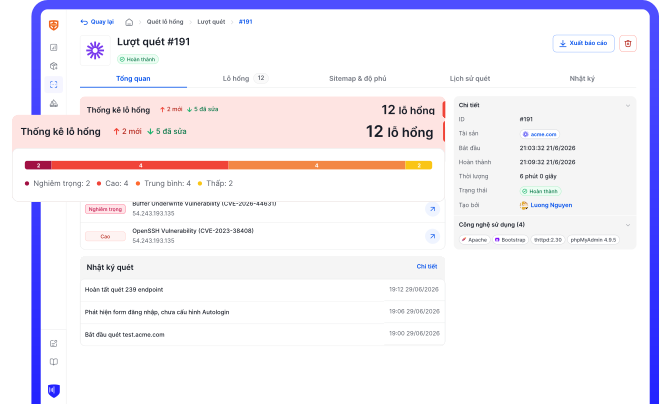
CyStack VulnScan dashboard