CWE-416 là gì?
Đang phân tích dữ liệu...
| Tác động | Phạm vi | Diễn giải |
|---|---|---|
| Thay đổi bộ nhớ | Tính toàn vẹn | The use of previously freed memory may corrupt valid data, if the memory area in question has been allocated and used properly elsewhere. |
| Từ chối dịch vụ: sập, thoát hoặc khởi động lại | Tính sẵn sàng | If chunk consolidation occurs after the use of previously freed data, the process may crash when invalid data is used as chunk information. |
| Đọc bộ nhớ | Tính bí mật | Read operations on freed memory can sometimes leak sensitive information instead of causing a crash |
| Thực thi mã hoặc lệnh trái phép | Tính toàn vẹn, Tính bí mật, Tính sẵn sàng | If malicious data is entered before chunk consolidation can take place, it may be possible to take advantage of a write-what-where primitive to execute arbitrary code. If the newly allocated data happens to hold a class, in C++ for example, various function pointers may be scattered within the heap data. If one of these function pointers is overwritten with an address to valid shellcode, execution of arbitrary code can be achieved. |
| Phương pháp | Cách làm | Hiệu quả |
|---|---|---|
| Kiểm thử fuzzing | Fuzz testing (fuzzing) is a powerful technique for generating large numbers of diverse inputs - either randomly or algorithmically - and dynamically invoking the code with those inputs. Even with random inputs, it is often capable of generating unexpected results such as crashes, memory corruption, or resource consumption. Fuzzing effectively produces repeatable test cases that clearly indicate bugs, which helps developers to diagnose the issues. | Cao |
| Phân tích tĩnh tự động | Automated static analysis, commonly referred to as Static Application Security Testing (SAST), can find some instances of this weakness by analyzing source code (or binary/compiled code) without having to execute it. Typically, this is done by building a model of data flow and control flow, then searching for potentially-vulnerable patterns that connect "sources" (origins of input) with "sinks" (destinations where the data interacts with external components, a lower layer such as the OS, etc.) | Cao |
| Phân tích động tự động | Use tools that are integrated during compilation to insert runtime error-checking mechanisms related to memory safety errors, such as AddressSanitizer (ASan) for C/C++ [REF-1518].Crafted inputs are necessary to reach the code containing the error, such as generated by fuzzers. Also, these tools may reduce performance, and they only report the error condition - not the original mistake that led to the error. | Khá |
Dưới đây là các lỗ hổng tiêu biểu liên quan đến CWE-416, dựa theo mức độ ưu tiên
CWE™ Program, operated by The MITRE Corporation. Copyright © 2006–2026, The MITRE Corporation. The MITRE Corporation hereby grants you a non-exclusive, royalty-free license to use CWE for research, development, and commercial purposes. CWE Terms of Use.
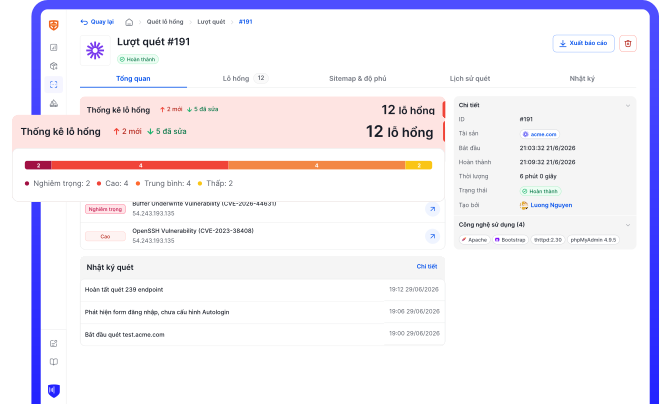
Giải pháp CyStack VulnScan liên tục phát hiện tài sản, xác minh lỗ hổng và giúp đội ngũ bảo mật ưu tiên khắc phục cho toàn bộ doanh nghiệp.
Khám phá CyStack VulnScanvi